
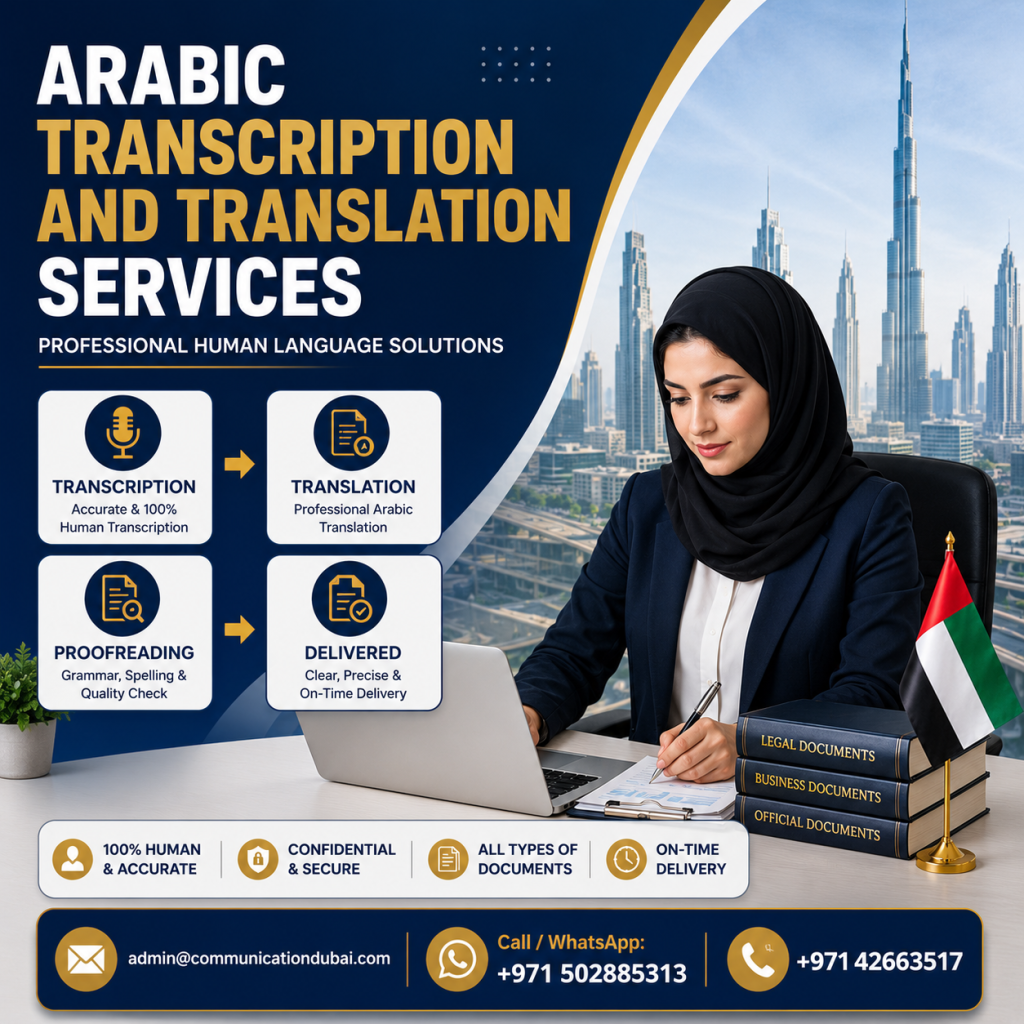
Arabic Transcription and Translation Services
Arabic Transcription and Translation Services – Professional Human Language Solutions
Arabic audio and video content is used across business meetings, legal proceedings, interviews, media productions, academic research, healthcare, customer support, conferences, and online education. When spoken Arabic must be converted into a written document or translated into another language, accuracy is essential.
Professional Arabic transcription and translation services help organisations and individuals turn recorded speech into clear, structured, and usable text. A recording can first be transcribed in Arabic and then translated into English or another required language. Depending on the project, the final content may also include speaker labels, timestamps, subtitles, captions, or professional document formatting.
Communication Legal Translation has provided professional language services since 1996. Our experienced human linguists support legal, business, medical, academic, technical, media, and personal projects. We work with more than 75 languages and provide confidential file handling, careful quality checks, competitive pricing, and dependable delivery.
What Are Arabic Transcription Services?
Arabic transcription is the process of listening to spoken Arabic in an audio or video recording and converting it into written Arabic text.
A professional transcriber listens carefully to identify:
- Spoken words
- Different speakers
- Names and titles
- Dates and figures
- Technical terminology
- Repeated statements
- Unclear sections
- Changes in language or dialect
- Important background information
- Relevant non-verbal sounds
The completed transcript may be delivered as a clean, easy-to-read document or as a detailed record that closely reflects the original speech.
Arabic transcription may be required for interviews, meetings, court recordings, research materials, webinars, lectures, podcasts, telephone calls, video content, and internal business communication.
Arabic Transcription and English Translation
Many clients require both transcription and translation. In this process, the Arabic recording is first converted into written Arabic and then translated into English.
This two-stage method allows the content to be checked more carefully and provides clients with both the original Arabic transcript and the English translation where requested.
The process normally includes:
- Listening to the complete recording.
- Identifying speakers and the subject.
- Transcribing the spoken Arabic.
- Reviewing the Arabic transcript.
- Translating the transcript into English.
- Editing and proofreading the translation.
- Adding timestamps or formatting where required.
- Delivering the completed files securely.
A direct translation from audio without preparing an Arabic transcript may also be possible for some projects. However, creating both versions can be helpful for legal, academic, research, or quality-control purposes.
Modern Standard Arabic and Arabic Dialects
Arabic is used across many countries, and spoken varieties can differ significantly. A speaker from the Gulf region may use expressions that are different from those used in Egypt, North Africa, the Levant, or other Arabic-speaking areas.
Our Arabic language projects may involve:
- Modern Standard Arabic
- Gulf Arabic
- Emirati Arabic
- Saudi Arabic
- Egyptian Arabic
- Levantine Arabic
- Iraqi Arabic
- Sudanese Arabic
- North African Arabic
- Mixed Arabic and English speech
Dialect identification is important because the same word may have different meanings depending on the region and context.
Recordings may also contain code-switching, where speakers move between Arabic and English or use technical terms from another language. Experienced human linguists can identify these changes and represent them appropriately in the transcript and translation.
Verbatim Arabic Transcription
Verbatim transcription records speech as closely as possible to the original audio.
It may include:
- Repetitions
- Incomplete sentences
- Hesitations
- Filler words
- False starts
- Interruptions
- Pauses
- Relevant background sounds
- Emotional expressions
- Overlapping speech
Verbatim transcription may be suitable for court evidence, legal investigations, academic research, interviews, police recordings, and projects where the exact speaking style is important.
Clients should explain how the transcript will be used so the correct level of detail can be applied.
Clean Arabic Transcription
Clean transcription focuses on readability while preserving the speaker’s intended meaning. Unnecessary filler words, repeated phrases, and obvious speech mistakes may be removed where appropriate.
The transcriber does not change the facts or introduce new meaning. The objective is to produce a professional document that reads smoothly.
Clean transcription is commonly used for:
- Business meetings
- Conferences
- Training sessions
- Webinars
- Podcasts
- Media interviews
- Lectures
- Internal communication
- Marketing videos
- Online courses
This format is often easier for readers who need the information rather than a detailed analysis of the way it was spoken.
Arabic Legal Transcription and Translation
Legal recordings require exceptional attention because individual words, pauses, names, dates, and statements may be important.
We assist with Arabic legal audio and video content such as:
- Court hearings
- Witness interviews
- Legal consultations
- Police recordings
- Arbitration sessions
- Recorded statements
- Depositions
- Internal investigations
- Lawyer-client meetings
- Dispute-related calls
Legal transcription may require exact speaker identification, accurate timestamps, verbatim wording, and clear marking of inaudible sections.
A legal translator should not interpret the evidence, change the speaker’s meaning, or correct statements in a way that affects the record. The transcript and translation should represent the source material as accurately as possible.
Legal acceptance requirements may vary. Clients should confirm whether the receiving authority requires a particular format, translator declaration, certification, notarisation, or other supporting documentation.
Business Meeting Transcription
Companies often record meetings, interviews, presentations, training sessions, and conference calls for documentation or future reference.
Our Arabic business transcription services cover:
- Board meetings
- Management discussions
- Sales meetings
- Employee interviews
- Training sessions
- Client calls
- Corporate presentations
- Market research interviews
- Focus groups
- Conferences
A professionally prepared transcript allows the organisation to create meeting minutes, review decisions, identify action items, prepare reports, and share information with team members.
When translation is required, the Arabic transcript can be converted into professional English or another supported language for international management, investors, partners, or employees.
Arabic Media and Video Transcription
Arabic media content may need transcription for editing, translation, subtitles, captions, search optimisation, accessibility, and content repurposing.
We handle:
- Interviews
- Documentaries
- News reports
- Podcasts
- YouTube videos
- Social media videos
- Promotional videos
- Online courses
- Television programmes
- Corporate films
A written transcript can be reused for articles, blogs, press releases, training documents, social media captions, or website content.
Media transcription may include timecodes so editors can locate specific sentences or sections in the recording.
Arabic Subtitle Translation Services
Arabic transcription is often the first step in professional subtitle production.
Our subtitle-related services may include:
- Arabic audio transcription
- Arabic to English subtitle translation
- English to Arabic subtitle translation
- Speaker identification
- Timestamping
- Subtitle text preparation
- Caption translation
- Review and proofreading
Subtitles must be concise enough to read comfortably while preserving the speaker’s intended meaning. Spoken language may need careful restructuring because a complete spoken sentence can be too long for the screen.
Translators also consider reading speed, timing, line length, tone, cultural references, and the relationship between the dialogue and the visual content.
Medical Transcription and Translation
Arabic medical recordings may involve consultations, interviews, research discussions, training, or patient communication.
We assist with:
- Doctor-patient consultations
- Medical interviews
- Clinical research recordings
- Healthcare training
- Expert discussions
- Medical conference sessions
- Insurance-related interviews
- Patient statements
Medical transcription requires knowledge of medical conditions, procedures, medicines, measurements, and healthcare terminology.
Recordings and transcripts may contain sensitive personal information. Confidential handling is therefore essential throughout the project.
Academic and Research Transcription
Students, universities, researchers, and educational institutions may require Arabic transcription for qualitative research, interviews, lectures, seminars, and field studies.
We transcribe and translate:
- Research interviews
- Focus groups
- Academic lectures
- Student discussions
- Oral histories
- Conference presentations
- Educational videos
- Recorded surveys
- Thesis research materials
- Training programmes
Research projects may require verbatim transcription, speaker codes, timestamps, or specific formatting. Clients should provide their preferred style guide or template at the beginning of the project.
Consistent formatting across multiple interviews helps researchers organise, compare, and analyse the information more effectively.
Time-Coded Arabic Transcription
Timecodes show when particular words or sections appear in the recording.
They may be inserted:
- At regular intervals
- At every speaker change
- At the beginning of each paragraph
- At important sections
- Around unclear or inaudible speech
- According to a client-provided format
Time-coded transcription is useful for video editing, legal review, subtitle creation, research, and quality assurance.
Clients should specify how frequently timestamps are required because detailed timecoding may affect the total processing time and cost.
Challenges in Arabic Audio Transcription
The quality of the transcript depends partly on the quality of the recording.
Common challenges include:
- Background noise
- Low recording volume
- Multiple people speaking together
- Strong regional dialects
- Poor microphone quality
- Telephone distortion
- Echo
- Fast speech
- Unfamiliar names
- Specialised terminology
- Incomplete recordings
- Mixed languages
When speech cannot be understood confidently, the unclear section should be marked rather than guessed.
Clients can improve accuracy by providing speaker names, technical glossaries, meeting agendas, company names, project background, and other relevant reference materials.
Human Transcription vs Automatic Speech Recognition
Automatic speech-recognition tools can generate rough text quickly, but they may struggle with Arabic dialects, overlapping speakers, background noise, names, and specialised terminology.
Automated systems may produce errors involving:
- Similar-sounding Arabic words
- Regional expressions
- Personal names
- Company names
- Legal vocabulary
- Medical terminology
- Numbers and dates
- Mixed Arabic and English
- Speaker identification
- Punctuation
Human transcribers listen to the full recording, use context, identify speakers, check unclear sections, and organise the final document professionally.
Technology may support parts of the workflow, but human review is essential for recordings that will be used in legal, medical, academic, commercial, or public-facing contexts.
Confidential Arabic Transcription Services
Audio and video files may contain personal, legal, financial, medical, corporate, or commercially sensitive information.
A professional service should protect confidentiality during:
- File transfer
- Project assessment
- Transcription
- Translation
- Editing
- Internal review
- Final delivery
- File retention or deletion
Clients should inform the translation provider when a project has special security requirements or requires a confidentiality agreement.
Our Arabic Transcription and Translation Process
We follow a structured workflow for every project.
Recording Assessment
We review the file format, duration, audio quality, number of speakers, dialect, subject, and requested delivery time.
Requirement Confirmation
We confirm whether the client needs verbatim or clean transcription, translation, speaker labels, timestamps, subtitles, or a specific template.
Linguist Assignment
The project is assigned to a qualified human linguist with relevant Arabic dialect and subject knowledge.
Arabic Transcription
The recording is converted into written Arabic with speaker identification and timestamps where requested.
Translation
The reviewed Arabic transcript is translated into English or another target language.
Editing and Proofreading
The transcript and translation are checked for accuracy, grammar, consistency, names, figures, terminology, and formatting.
Final Delivery
The completed files are delivered securely in the agreed format.
Why Choose Communication Legal Translation?
Communication Legal Translation has supported clients since 1996 with professional human language services.
Clients choose us for:
- Experienced Arabic transcribers
- Human translators
- Support for different Arabic dialects
- More than 75 languages
- Legal and industry knowledge
- Confidential file handling
- Verbatim and clean transcription
- Timestamp and speaker-label options
- Professional proofreading
- Competitive pricing
- Fast turnaround options
- Responsive customer support
We assist with short recordings as well as large collections of interviews, meetings, legal files, educational content, and media projects.
Frequently Asked Questions
Can you transcribe Arabic audio and translate it into English?
Yes. We can prepare an Arabic transcript and translate the content into English or another supported language.
Do you handle different Arabic dialects?
Yes. We work with several regional Arabic varieties. The availability of a suitable linguist may depend on the dialect, recording quality, and subject.
Can you add speaker names and timestamps?
Yes. Speaker labels and timestamps can be included according to the project requirements.
Do you provide verbatim transcription?
Yes. We offer verbatim and clean transcription. The correct option depends on the intended use of the recording.
Can you prepare subtitles?
We can provide transcription, translation, timestamped text, and subtitle-related language support based on the required format.
How is the cost calculated?
Pricing may depend on the recording length, audio quality, number of speakers, dialect, subject complexity, translation language, timestamp requirements, and deadline.
Are recordings confidential?
Yes. We follow strict confidentiality and secure file-handling procedures.
Contact Communication Legal Translation
Accurate transcription and translation make Arabic audio and video content easier to review, share, analyse, publish, and use across languages.
Whether you need a business meeting, legal recording, interview, podcast, research session, medical discussion, conference, training video, or media production transcribed and translated, Communication Legal Translation is ready to assist.
Contact our team for professional Arabic transcription and translation services, experienced human linguists, secure file handling, careful proofreading, competitive pricing, and dependable support from a company serving clients since 1996.