
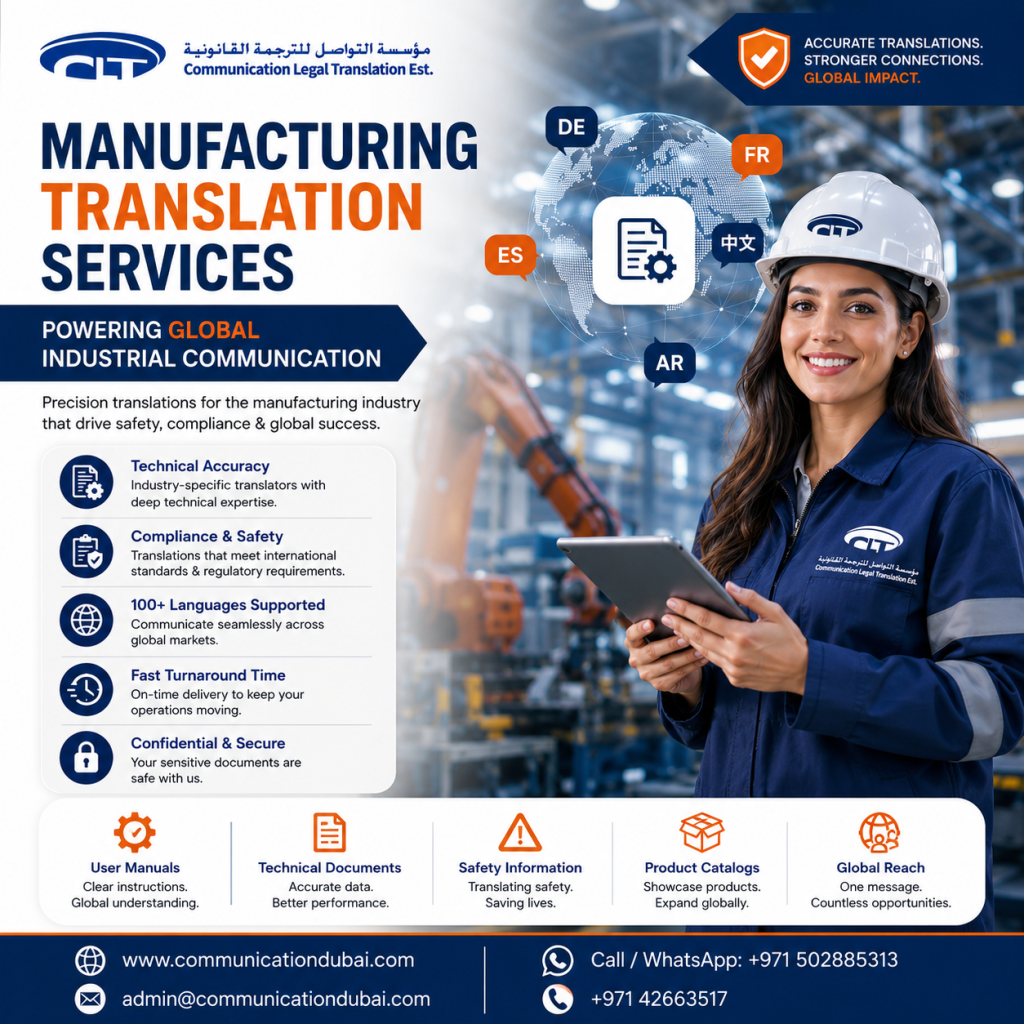
Manufacturing Translation Services: Powering Global Industrial Communication
Manufacturing is one of the most globalized industries in the world. From raw materials and production equipment to supply chains and international distribution networks, manufacturing companies regularly collaborate with suppliers, partners, customers, and regulators across multiple countries and languages.
As businesses expand into new markets, effective multilingual communication becomes essential. A single misunderstanding in a technical specification, operating manual, safety procedure, or production guideline can lead to costly delays, compliance issues, and operational risks.
This is why professional manufacturing translation services have become increasingly important. Accurate translation helps manufacturers communicate clearly, maintain quality standards, and operate efficiently across international markets.
At Communication Legal Translation Est. (CLT Translation Services), we provide professional manufacturing translation services in more than 75 languages, helping industrial organizations communicate accurately and confidently worldwide.
What Are Manufacturing Translation Services?
Manufacturing translation services involve translating industrial, technical, operational, and business-related content used within manufacturing environments.
These services help companies translate:
- Technical manuals
- Product specifications
- Manufacturing procedures
- Safety documentation
- Equipment guides
- Quality control documents
- Training materials
- Supply chain communication
The objective is to ensure technical accuracy while preserving the original meaning and functionality of the content.
Why Manufacturing Translation Is Important
Modern manufacturing operations often involve:
- International suppliers
- Global customers
- Multinational workforces
- Cross-border production facilities
- International compliance requirements
Without accurate translation, organizations may face:
- Production delays
- Equipment misuse
- Safety incidents
- Regulatory issues
- Quality control problems
Professional manufacturing translation reduces these risks while improving communication across global operations.
The Global Nature of Manufacturing
Manufacturing companies frequently operate across:
- North America
- Europe
- Middle East
- Asia-Pacific
- Latin America
- Africa
Products may be:
- Designed in one country
- Manufactured in another
- Distributed globally
This international environment requires multilingual communication at every stage of production and distribution.
Types of Manufacturing Documents That Require Translation
Technical Manuals
Technical manuals are among the most commonly translated manufacturing documents.
Examples include:
- Equipment manuals
- Installation guides
- Maintenance instructions
- Troubleshooting documents
Accurate translation helps operators use equipment safely and effectively.
Product Specifications
Manufacturers rely heavily on technical specifications.
These documents may include:
- Dimensions
- Material requirements
- Engineering tolerances
- Performance standards
Precision is critical because even small translation errors can affect production quality.
Standard Operating Procedures (SOPs)
SOPs help ensure consistent manufacturing processes.
Translation may be required for:
- Production workflows
- Assembly instructions
- Operational guidelines
- Process documentation
Clear communication supports operational efficiency.
Safety Documentation
Workplace safety remains a top priority in manufacturing environments.
Translated safety materials may include:
- Safety manuals
- Emergency procedures
- Hazard warnings
- Risk assessments
Accurate translation helps protect workers and improve compliance.
Quality Control Documents
Manufacturers use quality control documentation to maintain product standards.
Examples include:
- Inspection reports
- Testing procedures
- Quality assurance manuals
- Compliance checklists
Professional translation helps maintain consistency across facilities.
Training Materials
Manufacturing companies often employ multilingual teams.
Training materials may include:
- Employee handbooks
- Operational training guides
- Technical workshops
- Compliance training programs
Translation helps employees understand critical information.
Industries That Need Manufacturing Translation Services
Automotive Manufacturing
Automotive companies require translation for:
- Technical specifications
- Production documentation
- Maintenance manuals
- Supplier communication
Accurate translation supports quality and safety.
Electronics Manufacturing
Electronics manufacturers frequently translate:
- Product documentation
- Assembly procedures
- User manuals
- Technical specifications
Technical precision is essential.
Industrial Equipment Manufacturing
Industrial equipment suppliers often require multilingual support for:
- Installation manuals
- Maintenance procedures
- Operating guides
- Product catalogs
Translation improves customer support and product usability.
Aerospace Manufacturing
Aerospace documentation requires exceptional accuracy.
Examples include:
- Engineering specifications
- Maintenance documentation
- Compliance materials
- Technical manuals
Professional translation helps maintain industry standards.
Pharmaceutical Manufacturing
Pharmaceutical companies may require translation of:
- Production procedures
- Quality control documentation
- Regulatory materials
- Training programs
Accuracy is critical in healthcare-related manufacturing.
Food and Beverage Manufacturing
Food manufacturers often translate:
- Production procedures
- Product labels
- Safety guidelines
- Quality assurance documentation
Translation supports regulatory compliance and international distribution.
Benefits of Professional Manufacturing Translation
Improved Operational Efficiency
Employees and partners can clearly understand procedures and technical requirements.
Enhanced Workplace Safety
Accurate translation of safety materials reduces risks and improves compliance.
Better Quality Control
Consistent communication supports product quality across multiple locations.
Faster Global Expansion
Manufacturers can enter new markets more effectively with multilingual documentation.
Stronger Supplier Relationships
Clear communication improves collaboration with international suppliers and partners.
Reduced Risk of Errors
Professional translation minimizes misunderstandings that may affect production processes.
Manufacturing Translation vs General Translation
Manufacturing translation requires specialized expertise.
General translators may understand language, but manufacturing documents often contain:
- Technical terminology
- Engineering concepts
- Industry-specific standards
- Complex operational procedures
Professional manufacturing translators understand both language and industrial terminology.
Challenges in Manufacturing Translation
Technical Complexity
Manufacturing documentation often contains highly specialized language.
Industry Terminology
Different manufacturing sectors use unique terminology and standards.
Regulatory Requirements
Manufacturers must comply with regional and international regulations.
Consistency Across Documents
Large projects require consistent terminology across multiple documents and departments.
Professional translation teams use terminology management processes to ensure consistency.
Why Machine Translation Is Not Enough
Machine translation tools can assist with simple communication, but manufacturing documents require precision.
Automated systems often:
- Misinterpret technical terminology
- Produce inconsistent translations
- Miss industry-specific context
- Create safety risks
Human translators provide the accuracy required for industrial communication.
Confidentiality and Data Security
Manufacturing documents may contain:
- Product designs
- Technical specifications
- Proprietary processes
- Trade secrets
Professional translation providers implement:
- Confidential workflows
- Secure file handling
- Data protection procedures
- Controlled document access
Protecting intellectual property is essential.
Why Choose Communication Legal Translation Est.?
Since 1996, Communication Legal Translation Est. has supported businesses with professional multilingual communication solutions.
Our manufacturing translation services offer:
- Translation in 75+ languages
- Experienced technical translators
- Industry-specific expertise
- Fast turnaround times
- Strict confidentiality
- Comprehensive quality assurance
We help manufacturers communicate effectively across global markets.
Our Manufacturing Translation Process
Step 1: Project Review
We analyze the content and technical requirements.
Step 2: Translator Assignment
Projects are assigned to experienced technical language specialists.
Step 3: Translation
Documents are translated with industry-specific terminology.
Step 4: Quality Assurance
Translations undergo proofreading and terminology verification.
Step 5: Delivery
Final documents are delivered according to client requirements.
Future Trends in Manufacturing Translation
As manufacturing becomes increasingly global and digital, demand for multilingual communication will continue growing.
Emerging trends include:
- Smart manufacturing
- Industrial automation
- International supply chains
- Global compliance requirements
- Digital transformation initiatives
Professional translation will remain an essential component of international manufacturing success.
Conclusion
Manufacturing translation services play a critical role in supporting global industrial communication.
From technical manuals and safety procedures to quality documentation and training materials, accurate translation helps manufacturers improve efficiency, maintain compliance, enhance safety, and expand internationally.
Professional human translation ensures that complex manufacturing information remains clear, accurate, and reliable across languages and markets.
For organizations seeking to strengthen international operations, manufacturing translation services provide a valuable foundation for successful global communication.
FAQs
1. What are manufacturing translation services?
Manufacturing translation services involve translating technical, operational, and industrial documents used within manufacturing environments.
2. Why is manufacturing translation important?
It improves communication, enhances safety, supports compliance, and reduces production errors.
3. What manufacturing documents are commonly translated?
Technical manuals, safety procedures, product specifications, training materials, and quality control documents.
4. Can machine translation be used for manufacturing documents?
Professional human translation is recommended because manufacturing documents require technical accuracy and industry expertise.
5. Are manufacturing documents kept confidential?
Yes. Professional translation providers use secure processes to protect technical and proprietary information.