
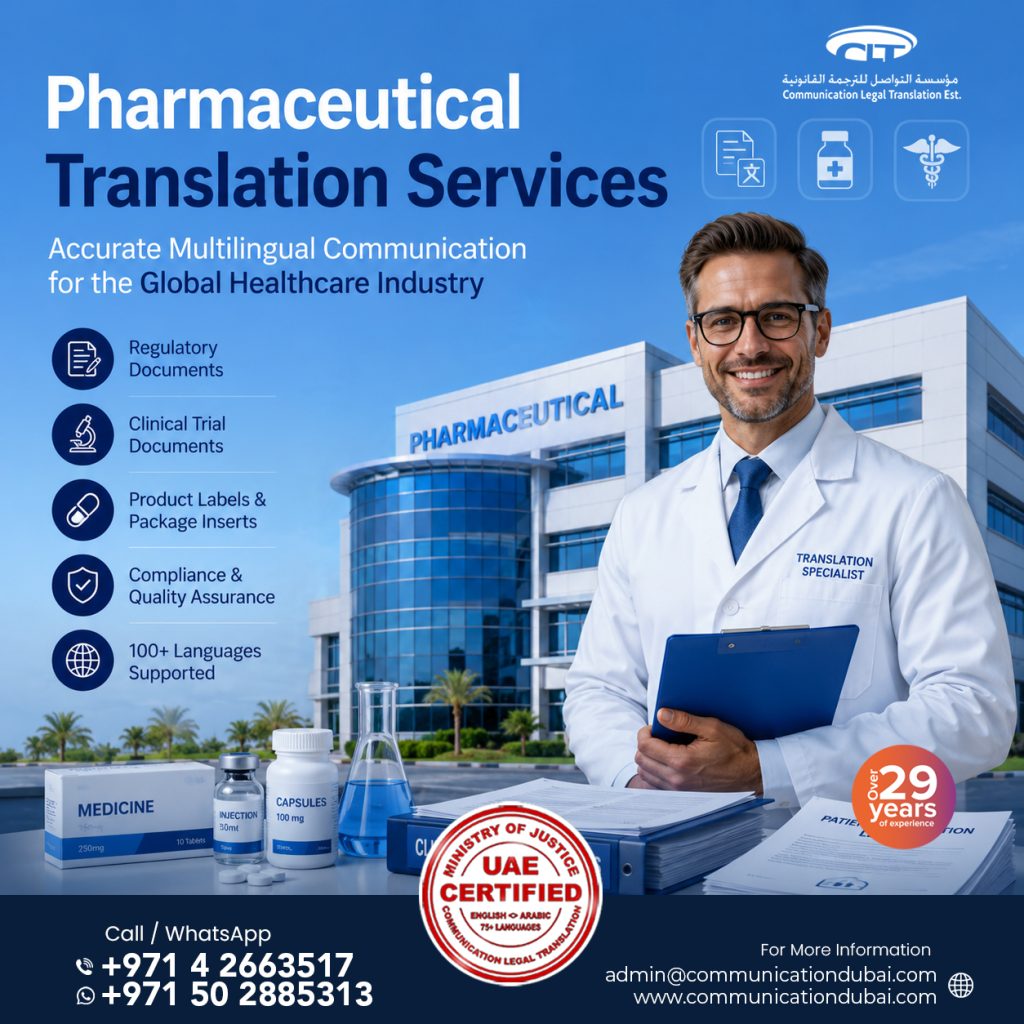
Pharmaceutical Translation Services: Accurate Multilingual Communication for the Global Healthcare Industry
The pharmaceutical industry operates on a global scale, connecting researchers, manufacturers, healthcare providers, regulatory authorities, and patients across multiple countries and languages. In such a highly regulated sector, accurate communication is essential. Even a minor translation error can affect patient safety, regulatory compliance, product approvals, or clinical research outcomes.
This is why professional pharmaceutical translation services play a critical role in the healthcare and life sciences industry. From drug development and clinical trials to regulatory submissions and patient information leaflets, pharmaceutical organizations require precise multilingual communication.
At Communication Legal Translation Est. (CLT Translation Services), we provide professional pharmaceutical translation services in more than 75 languages, helping healthcare and pharmaceutical organizations communicate accurately and confidently across international markets.
What Are Pharmaceutical Translation Services?
Pharmaceutical translation services involve translating pharmaceutical, medical, scientific, and regulatory content while maintaining:
- Technical accuracy
- Medical terminology
- Regulatory compliance
- Scientific integrity
- Patient safety information
Professional pharmaceutical translators combine language expertise with knowledge of healthcare and pharmaceutical terminology.
Why Pharmaceutical Translation Is Important
The pharmaceutical sector depends on precise communication throughout every stage of a product’s lifecycle.
Professional translation helps:
- Support global product launches
- Improve patient safety
- Facilitate international clinical trials
- Meet regulatory requirements
- Improve healthcare communication
- Expand into international markets
Accurate translation reduces risks and enhances operational efficiency.
The Global Nature of the Pharmaceutical Industry
Pharmaceutical companies often operate across:
- North America
- Europe
- Middle East
- Asia-Pacific
- Latin America
- Africa
Products developed in one country may be manufactured, tested, distributed, and sold across multiple international markets.
Professional translation helps ensure consistency throughout global operations.
Types of Pharmaceutical Documents That Require Translation
Regulatory Documents
Regulatory submissions are among the most critical pharmaceutical documents.
Examples include:
- Registration dossiers
- Regulatory applications
- Product approvals
- Compliance reports
Accuracy is essential to support approval processes.
Clinical Trial Documentation
Clinical research often involves multilingual participants and international stakeholders.
Common documents include:
- Clinical trial protocols
- Informed consent forms
- Investigator brochures
- Clinical study reports
Professional translation supports research integrity and participant understanding.
Patient Information Leaflets
Patients rely on accurate information regarding medications.
Translations may include:
- Dosage instructions
- Usage guidelines
- Safety warnings
- Side effects information
Clear communication helps improve patient safety.
Product Packaging and Labels
Pharmaceutical packaging frequently requires multilingual content.
Examples include:
- Labels
- Packaging inserts
- Product descriptions
- Safety information
Translation accuracy supports regulatory compliance and patient understanding.
Manufacturing Documentation
Pharmaceutical manufacturers often translate:
- Standard operating procedures (SOPs)
- Production guidelines
- Quality assurance documents
- Equipment manuals
Consistent terminology helps maintain operational quality.
Scientific and Research Content
Research organizations regularly require translation of:
- Scientific publications
- Research papers
- Laboratory reports
- Technical documentation
Specialized expertise ensures scientific accuracy.
Industries That Need Pharmaceutical Translation Services
Pharmaceutical Manufacturers
Manufacturers require multilingual communication throughout product development and distribution.
Biotechnology Companies
Biotech organizations often translate research and regulatory materials.
Clinical Research Organizations (CROs)
Clinical studies frequently involve international participants and investigators.
Healthcare Providers
Hospitals and healthcare organizations use translated pharmaceutical information to support patient care.
Regulatory Agencies
Government authorities often review multilingual pharmaceutical documentation.
Medical Device Companies
Many pharmaceutical translation projects overlap with healthcare technology and medical device industries.
Benefits of Professional Pharmaceutical Translation
Improved Patient Safety
Accurate translation helps patients understand medication instructions and warnings.
Regulatory Compliance
Professional translation supports compliance with international regulatory standards.
Faster Market Expansion
Companies can launch products more effectively in new markets.
Better Clinical Trial Management
Multilingual communication improves collaboration and participant understanding.
Increased Credibility
Professional communication enhances trust among regulators, healthcare providers, and patients.
Reduced Risk
Accurate translation helps prevent costly misunderstandings and compliance issues.
Challenges in Pharmaceutical Translation
Complex Terminology
Pharmaceutical documents contain highly specialized medical and scientific language.
Regulatory Requirements
Different countries have unique regulatory standards and documentation requirements.
Scientific Accuracy
Even minor translation errors can affect understanding and compliance.
Consistency Across Documents
Large pharmaceutical projects require consistent terminology across numerous documents and departments.
Professional translators use terminology management tools to maintain consistency.
Pharmaceutical Translation vs General Translation
Pharmaceutical translation requires specialized expertise beyond general language skills.
Translators must understand:
- Medical terminology
- Pharmaceutical concepts
- Clinical research
- Regulatory requirements
- Scientific communication
Industry expertise is essential for high-quality results.
Why Human Translation Is Essential
While AI and machine translation technologies continue improving, pharmaceutical communication requires a high level of precision.
Machine translation may:
- Misinterpret medical terminology
- Miss scientific context
- Create inconsistencies
- Introduce patient safety risks
Human translators provide:
- Medical expertise
- Contextual understanding
- Quality control
- Regulatory awareness
For pharmaceutical content, professional human review remains essential.
Confidentiality and Data Security
Pharmaceutical documents often contain sensitive information such as:
- Research data
- Clinical trial results
- Product development information
- Regulatory submissions
Professional translation providers implement:
- Secure workflows
- Confidential handling
- Data protection procedures
- Restricted access systems
Protecting proprietary information is critical.
Why Choose Communication Legal Translation Est.?
Since 1996, Communication Legal Translation Est. has supported healthcare organizations, pharmaceutical companies, and international businesses with professional multilingual communication solutions.
Our strengths include:
- Translation support in 75+ languages
- Experienced healthcare and pharmaceutical translators
- Industry-specific expertise
- Fast turnaround times
- Strict confidentiality
- Quality assurance processes
We help organizations communicate effectively across global healthcare markets.
Our Pharmaceutical Translation Process
Step 1: Project Assessment
We review the content type, terminology requirements, and target audience.
Step 2: Specialist Assignment
Projects are assigned to translators experienced in healthcare and pharmaceutical terminology.
Step 3: Translation
Content is translated while preserving scientific and technical accuracy.
Step 4: Quality Assurance
Translations undergo proofreading and terminology verification.
Step 5: Final Delivery
Completed projects are delivered according to client specifications.
Future of Pharmaceutical Translation
As global healthcare continues expanding, demand for pharmaceutical translation services is expected to increase.
Growth drivers include:
- International clinical trials
- Global drug development
- Healthcare innovation
- Regulatory harmonization
- Digital health technologies
Professional translation will remain essential for supporting safe and effective healthcare communication.
Conclusion
Pharmaceutical translation services play a critical role in helping healthcare organizations, pharmaceutical companies, researchers, and regulators communicate accurately across international markets.
From clinical trials and regulatory submissions to patient information and scientific research, professional translation helps improve patient safety, support compliance, and facilitate global healthcare innovation.
By investing in professional human translation, pharmaceutical organizations can strengthen communication, reduce risk, and improve international collaboration.
At Communication Legal Translation Est. (CLT Translation Services), we provide reliable pharmaceutical translation solutions designed to support the evolving needs of the global healthcare industry.
FAQs
1. What are pharmaceutical translation services?
Pharmaceutical translation services involve translating medical, scientific, regulatory, and pharmaceutical documents while maintaining technical accuracy and compliance.
2. Why is pharmaceutical translation important?
It supports patient safety, regulatory compliance, clinical research, and international market expansion.
3. What pharmaceutical documents are commonly translated?
Clinical trial documents, patient information leaflets, regulatory submissions, manufacturing procedures, and scientific research papers.
4. Can machine translation be used for pharmaceutical content?
Professional human translation is strongly recommended because pharmaceutical content requires scientific accuracy and regulatory compliance.
5. Are pharmaceutical documents confidential?
Yes. Professional translation providers use strict confidentiality procedures and secure workflows to protect sensitive healthcare and research information.