
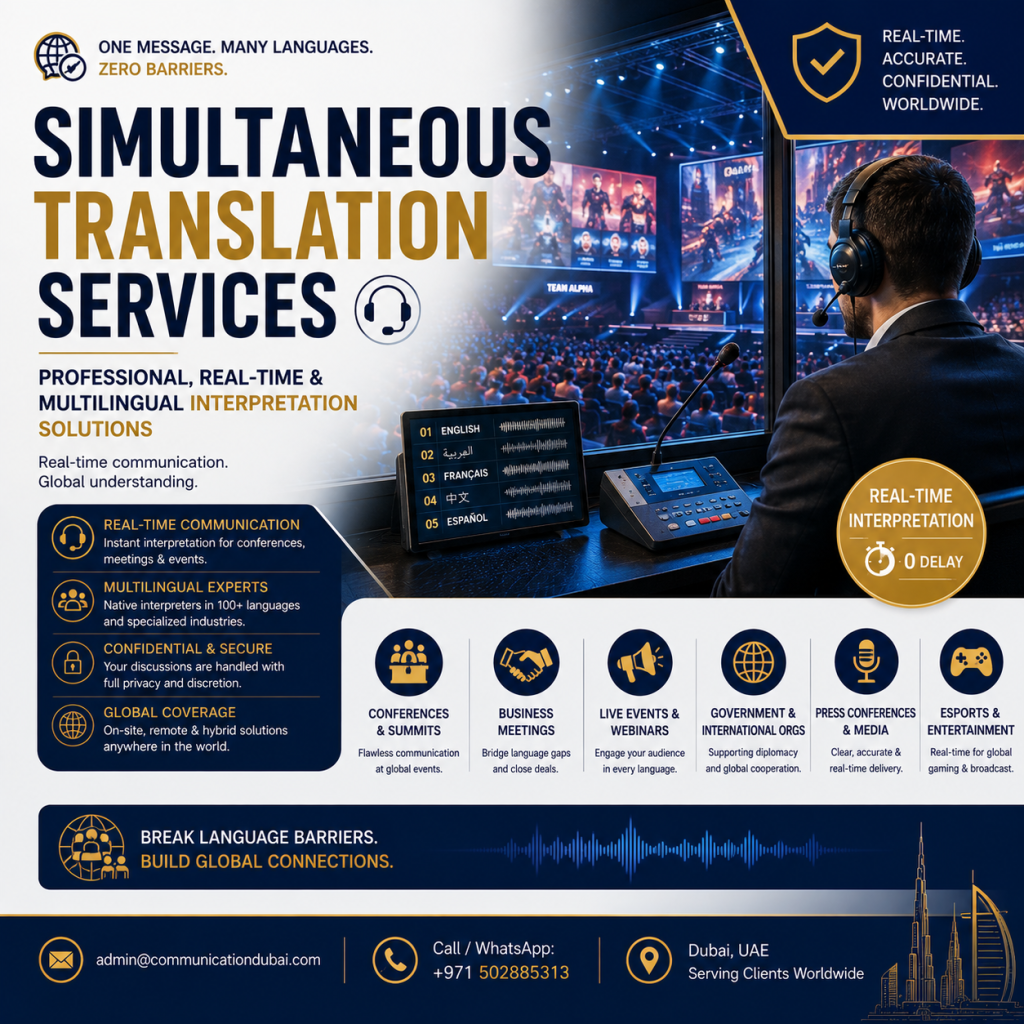
Simultaneous Translation Services
Simultaneous Translation Services – Professional, Real-Time & Multilingual Interpretation Solutions
In international conferences, business meetings, government events, seminars, exhibitions, training sessions, legal discussions, and large corporate gatherings, communication often needs to happen instantly. Simultaneous Translation Services, more accurately known in many professional settings as simultaneous interpretation services, allow speakers and audiences to communicate across languages in real time without repeatedly stopping the event.
At Communication Legal Translation, we provide professional multilingual language solutions across more than 75 languages. Our simultaneous interpretation and related translation services can support businesses, event organizers, law firms, government-related organizations, hotels, conference venues, training providers, healthcare organizations, international companies, and professional associations in Dubai, throughout the UAE, and internationally.
Whether you need simultaneous interpretation for a conference, Arabic-English interpretation for a corporate meeting, multilingual event interpretation, remote simultaneous interpretation, booth interpretation, or real-time language support, each project can be reviewed according to the languages, event format, number of participants, subject matter, venue, technical setup, and schedule.
What Are Simultaneous Translation Services?
Simultaneous translation usually refers to a form of live interpretation in which an interpreter listens to a speaker and delivers the message into another language almost immediately.
Unlike written translation, simultaneous interpretation happens in real time.
It is commonly used for:
- Conferences
- Seminars
- Business Meetings
- International Events
- Government-related Meetings
- Training Sessions
- Exhibitions
- Large Corporate Events
- Webinars
- Hybrid Events
The objective is to allow listeners to understand the speaker without significant interruption.
Simultaneous Translation vs Simultaneous Interpretation
The terms are often used interchangeably online, but they are technically different.
Translation
Translation generally refers to written content.
Examples include:
- Contracts
- Reports
- Websites
- Brochures
- Presentations
Interpretation
Interpretation refers to spoken communication.
Examples include:
- Conferences
- Meetings
- Interviews
- Events
- Training Sessions
Therefore, when people search for simultaneous translation services, they are often actually looking for professional simultaneous interpretation services.
How Does Simultaneous Interpretation Work?
During simultaneous interpretation, the interpreter listens to the speaker through audio equipment and communicates the meaning in the target language with only a short delay.
A typical setup can include:
- Speaker
- Interpreter
- Microphone
- Headset
- Interpreter Booth
- Receiver
- Audience Headsets
- Sound System
The exact technical setup depends on the event.
Why Use Simultaneous Translation Services?
Simultaneous interpretation can be useful when an event must continue smoothly without long pauses.
Benefits can include:
- Real-Time Communication
- Faster Event Flow
- Multilingual Participation
- Better Audience Understanding
- Professional International Communication
- Reduced Repetition
- Improved Conference Experience
This can be particularly useful for events with large audiences.
Simultaneous Translation Services in Dubai
Dubai hosts conferences, exhibitions, corporate meetings, government events, international trade shows, training programs, and professional seminars throughout the year.
Professional simultaneous interpretation can support events involving:
- Arabic
- English
- French
- German
- Spanish
- Russian
- Chinese
- Japanese
- Korean
- Hindi
- Urdu
- Other Languages
Arabic-English simultaneous interpretation is especially relevant for many events in Dubai and the wider UAE.
Simultaneous Translation Services UAE
Professional simultaneous interpretation can support events across:
- Dubai
- Abu Dhabi
- Sharjah
- Ajman
- Ras Al Khaimah
- Fujairah
- Umm Al Quwain
Services may be suitable for both private and public-facing events depending on project requirements.
Arabic English Simultaneous Translation Services
Arabic-English interpretation is commonly required in the UAE.
It can support:
- Corporate Meetings
- Conferences
- Seminars
- Training Sessions
- Business Events
- Legal Discussions
- Exhibitions
- Public Events
Professional interpreters should understand both languages and the relevant subject matter.
English to Arabic Simultaneous Interpretation
English-to-Arabic simultaneous interpretation can support international speakers addressing Arabic-speaking audiences.
Common settings include:
- Conferences
- Product Launches
- Training
- Business Meetings
- Government-related Events
- Corporate Presentations
The interpreter should preserve meaning, tone, and intent.
Arabic to English Simultaneous Interpretation
Arabic-to-English simultaneous interpretation can support Arabic-speaking participants communicating with international audiences.
It can be useful for:
- Panel Discussions
- Meetings
- Conferences
- Interviews
- Business Presentations
- Media Events
The interpretation should sound natural rather than word-for-word.
Conference Interpretation Services
Conferences are among the most common uses of simultaneous interpretation.
Services can support:
- International Conferences
- Academic Conferences
- Medical Conferences
- Legal Conferences
- Technology Conferences
- Business Conferences
- Industry Summits
Large conferences may require several interpreters and language booths.
Multilingual Conference Interpretation
International conferences may require several languages at the same time.
For example:
- Arabic
- English
- French
- Spanish
- German
- Russian
- Chinese
Each language may require a dedicated interpreter or interpretation team.
Conference Interpreter Services
Conference interpreters may work from:
- Professional Booths
- Portable Booths
- Remote Platforms
- Dedicated Event Areas
The correct setup depends on venue size, audience, language requirements, and event format.
Business Meeting Interpretation
Businesses may require simultaneous interpretation during:
- Board Meetings
- Partner Meetings
- Negotiations
- Corporate Presentations
- Strategy Meetings
- International Delegations
Interpretation can help participants communicate without slowing the meeting significantly.
Corporate Interpretation Services
Corporate interpretation may support:
- Management Meetings
- Employee Events
- Investor Meetings
- Training Sessions
- Sales Conferences
- Annual Meetings
Industry terminology should be shared with interpreters before the event where possible.
Board Meeting Interpretation
Board meetings may involve:
- Financial Results
- Corporate Strategy
- Legal Matters
- Investment
- Governance
- Risk Management
The interpreter may need familiarity with corporate and financial terminology.
International Business Interpretation
International companies often work with teams, suppliers, partners, and clients across different countries.
Interpretation can support:
- Negotiations
- Presentations
- Partnerships
- Contract Discussions
- Investor Communication
Professional communication is particularly important during high-value discussions.
Government Event Interpretation
Government-related meetings and public-sector events may require professional interpretation for:
- International Delegations
- Conferences
- Public Programs
- Workshops
- Official Meetings
- Training
Formal terminology and confidentiality may be important depending on the event.
Simultaneous Translation Services
Diplomatic Interpretation Services
Diplomatic and international-relations events can require highly professional interpreters.
Settings can include:
- Bilateral Meetings
- Delegation Visits
- International Forums
- Diplomatic Conferences
Tone, protocol, and terminology should be handled carefully.
Legal Simultaneous Interpretation
Legal settings may sometimes require simultaneous interpretation for:
- Conferences
- Arbitration
- Large Legal Meetings
- Seminars
- Training
Legal terminology requires specialist knowledge.
Arbitration Interpretation Services
International arbitration may involve participants from multiple countries.
Interpretation can support:
- Hearings
- Witness Statements
- Legal Presentations
- Expert Discussions
- Procedural Meetings
The appropriate interpretation mode depends on the hearing format and requirements.
Legal Conference Interpretation
Legal conferences may discuss:
- Corporate Law
- Arbitration
- Intellectual Property
- Compliance
- International Trade
- Litigation
Interpreters should understand formal legal terminology.
Medical Conference Interpretation
Medical and healthcare conferences can require specialist interpretation.
Topics may include:
- Medicine
- Surgery
- Pharmaceuticals
- Healthcare
- Medical Devices
- Clinical Research
- Public Health
Medical terminology can be complex, so interpreters should have appropriate subject familiarity.
Healthcare Event Interpretation
Healthcare organizations may require interpretation for:
- Conferences
- Training
- Workshops
- Professional Meetings
- Public Health Events
The correct terminology should be prepared before the event.
Pharmaceutical Conference Interpretation
Pharmaceutical events can involve:
- Clinical Trials
- Drug Development
- Regulatory Topics
- Pharmacovigilance
- Scientific Research
- Product Information
Specialized terminology preparation is especially important.
Life Sciences Interpretation Services
Life sciences interpretation can support:
- Scientific Conferences
- Research Meetings
- Biotechnology Events
- Medical Device Events
- Pharmaceutical Conferences
Interpreters may require detailed briefing materials.
Technical Conference Interpretation
Technical interpretation can support events involving:
- Engineering
- Manufacturing
- Construction
- IT
- Telecommunications
- Energy
- Automotive
Technical terminology should be shared in advance where possible.
Engineering Interpretation Services
Engineering events can discuss:
- Project Specifications
- Equipment
- Safety
- Construction
- Manufacturing
- Technical Design
Subject knowledge helps reduce ambiguity.
Technology Event Interpretation
Technology events can include:
- Software
- Artificial Intelligence
- Cybersecurity
- Cloud Computing
- Telecommunications
- Digital Transformation
Rapidly changing terminology makes preparation important.
Financial Interpretation Services
Financial events may require interpretation for:
- Investor Meetings
- Banking Conferences
- Annual Meetings
- Financial Presentations
- Investment Forums
Interpreters should be comfortable with figures, financial terminology, and business language.
Investor Meeting Interpretation
Investor communication may involve:
- Financial Performance
- Growth Strategy
- Forecasts
- Market Expansion
- Risk
Clear interpretation can support accurate communication between management and investors.
Banking Conference Interpretation
Banking events may discuss:
- Financial Markets
- Lending
- Regulation
- Investment
- Risk
- Compliance
Specialized financial terminology should be prepared in advance.
Training Interpretation Services
Training sessions may involve employees or participants who speak different languages.
Simultaneous interpretation can support:
- Corporate Training
- Technical Training
- Safety Training
- Medical Training
- Professional Development
- Workshops
This allows the trainer to continue speaking without repeated pauses.
Employee Training Interpretation
International companies may need multilingual interpretation for:
- Policies
- Procedures
- Compliance
- Health & Safety
- Product Training
- Technical Training
Terminology consistency can be important across multiple sessions.
Seminar Interpretation Services
Seminars may require simultaneous interpretation for:
- Business
- Education
- Healthcare
- Law
- Technology
- Professional Development
The interpreter should receive the agenda and supporting materials in advance where possible.
Workshop Interpretation
Workshops can be more interactive than conferences.
Interpretation may need to support:
- Presentations
- Questions
- Group Discussions
- Participant Feedback
The event format should be discussed before choosing simultaneous or another interpretation mode.
Exhibition Interpretation Services
International exhibitions attract participants from many countries.
Language support can assist:
- Exhibitors
- Visitors
- Buyers
- Sales Teams
- Business Delegations
Interpretation can support presentations, meetings, and product discussions.
Trade Show Interpretation
Trade shows may require interpretation for:
- Product Demonstrations
- Buyer Meetings
- Business Negotiations
- Presentations
- Press Events
The interpreter should understand the exhibitor’s products and industry terminology.
Expo Interpretation Services
Large expos can involve:
- International Pavilions
- Companies
- Government Delegations
- Investors
- Visitors
Several interpretation formats may be used during the same event.
Event Interpretation Services
Professional event interpretation can support:
- Conferences
- Exhibitions
- Seminars
- Product Launches
- Awards
- Training Sessions
- Corporate Events
Each event should be planned according to audience size and languages.
Product Launch Interpretation
International brands may require interpretation during:
- Product Presentations
- Media Events
- Dealer Meetings
- Launch Conferences
Interpreters should understand product names, specifications, and marketing terminology.
Press Conference Interpretation
Press conferences may require simultaneous interpretation so international media can follow speakers in real time.
Content can include:
- Corporate Announcements
- Government Statements
- Sports Events
- Product Launches
- Public Events
Quotes and factual information should be communicated carefully.
Media Event Interpretation
Media events can require interpretation for:
- Interviews
- Panels
- Press Conferences
- Announcements
- Launches
Professional delivery is important because interpreted statements may be quoted publicly.
Sports Event Interpretation
Sports organizations may require interpretation for:
- Press Conferences
- Athlete Interviews
- Tournaments
- Team Meetings
- International Events
- Sponsorship Events
Sports terminology and athlete names should be prepared in advance.
Football Conference Interpretation
Football-related interpretation can support:
- Club Meetings
- Player Announcements
- Coaching Conferences
- Sponsorship Events
- Press Conferences
Sports and business terminology may overlap.
Tourism Interpretation Services
Tourism organizations may require interpretation for:
- Travel Conferences
- Hospitality Events
- Tourism Exhibitions
- Destination Marketing
- International Delegations
The language should remain clear and engaging.
Hospitality Interpretation Services
Hotels and hospitality companies may need interpretation for:
- Conferences
- Staff Training
- Corporate Meetings
- Tourism Events
- International Guest Events
Hospitality terminology should be familiar to the interpreter.
Real Estate Interpretation Services
Real estate events can involve:
- Property Exhibitions
- Investor Meetings
- Sales Presentations
- Developer Conferences
- Property Launches
Interpretation can support communication between developers, agents, investors, and buyers.
Construction Interpretation Services
Construction and infrastructure projects may require interpretation for:
- Technical Meetings
- Conferences
- Safety Training
- Contractor Meetings
- Project Workshops
Technical and contractual terminology may need advance preparation.
Oil & Gas Interpretation Services
Energy-sector events may require specialized simultaneous interpretation.
Topics may involve:
- Operations
- Engineering
- Safety
- Energy Markets
- Projects
- Technology
Industry terminology can be highly specialized.
Energy Conference Interpretation
Energy conferences may cover:
- Renewable Energy
- Oil & Gas
- Sustainability
- Power Generation
- Energy Policy
- Technology
Interpreters should receive relevant terminology and presentation materials where possible.

Simultaneous Translation Services
Education Interpretation Services
Educational institutions may require simultaneous interpretation for:
- Conferences
- University Events
- Training
- Parent Sessions
- Academic Seminars
Academic terminology should remain clear and consistent.
Academic Conference Interpretation
Universities and researchers may require interpretation during:
- Research Conferences
- Lectures
- Academic Panels
- International Seminars
Specialized subject terminology can require advance preparation.
NGO & International Organization Interpretation
International organizations may require interpretation for:
- Conferences
- Workshops
- Public Programs
- Policy Discussions
- Training
Content may involve social, legal, humanitarian, or technical topics.
Simultaneous Interpretation Equipment
Professional simultaneous interpretation often requires specialist equipment.
This can include:
- Interpreter Booths
- Interpreter Consoles
- Microphones
- Headsets
- Transmitters
- Receivers
- Audience Headphones
- Sound Systems
The exact equipment depends on the venue and event.
Interpreter Booths
Professional booths allow interpreters to work in a controlled environment while hearing the speaker clearly.
Booths may be:
- Fixed
- Portable
- Mobile
The appropriate choice depends on the venue.
Portable Interpretation Equipment
Portable equipment can be useful for smaller events or venues without permanent interpretation facilities.
It may include:
- Wireless Transmitters
- Receivers
- Headsets
- Portable Microphones
Technical suitability should be assessed before the event.
Wireless Interpretation Systems
Wireless systems allow participants to hear interpretation through receivers and headsets.
These systems can be useful for:
- Conferences
- Tours
- Exhibitions
- Training
Signal quality and venue conditions should be considered.
Audience Headsets
Participants typically select the required language channel through a receiver and headset.
For large events, organizers should confirm:
- Number of Participants
- Number of Languages
- Equipment Quantity
- Seating Arrangement
Planning reduces technical problems during the event.
Interpreter Console
The interpreter console can allow interpreters to:
- Hear the Speaker
- Control Microphone
- Select Channels
- Monitor Audio
Professional audio quality is important because interpreters depend on clear speech.
Sound System Requirements
Poor audio quality can make simultaneous interpretation difficult.
The event setup should provide:
- Clear Speaker Audio
- Reliable Microphones
- Stable Sound Distribution
- Technical Support
Good audio is as important as interpreter quality.
Remote Simultaneous Interpretation Services
Remote simultaneous interpretation, often abbreviated as RSI, allows interpreters and participants to join from different locations.
It can be used for:
- Webinars
- Virtual Conferences
- Hybrid Meetings
- International Training
- Online Events
A reliable internet connection and suitable platform are important.
Online Simultaneous Translation Services
Online interpretation can help organizations connect participants from different countries without requiring everyone to attend the same physical venue.
Services can support:
- Zoom Meetings
- Virtual Conferences
- Webinars
- Online Training
- International Meetings
Platform capabilities should be checked before the event.
Zoom Simultaneous Interpretation
Certain online meeting platforms can support separate language channels.
Planning should include:
- Language Channels
- Interpreter Access
- Participant Instructions
- Technical Testing
- Backup Communication
A technical rehearsal may be useful.
Virtual Conference Interpretation
Virtual conferences can involve hundreds or thousands of participants.
Professional interpretation planning may include:
- Interpreter Teams
- Language Channels
- Platform Testing
- Moderator Coordination
- Technical Support
Hybrid Event Interpretation
Hybrid events combine in-person and remote participants.
Interpretation can involve:
- Onsite Speakers
- Remote Speakers
- Onsite Interpreters
- Remote Interpreters
- Online Participants
- In-Person Audience
Technical planning becomes especially important.
Simultaneous Interpretation for Webinars
Webinars may require multilingual access for international audiences.
Interpretation can support:
- Corporate Webinars
- Educational Webinars
- Medical Webinars
- Technical Training
- Product Demonstrations
Presentation materials should ideally be shared with interpreters in advance.
Simultaneous vs Consecutive Interpretation
Choosing between simultaneous and consecutive interpretation depends on the event.
Simultaneous Interpretation
The interpreter speaks almost at the same time as the speaker.
Suitable for:
- Large Conferences
- Seminars
- International Events
- Long Presentations
Consecutive Interpretation
The speaker pauses while the interpreter delivers the message.
Suitable for:
- Smaller Meetings
- Interviews
- Short Discussions
- Negotiations
Each method has different advantages.
Simultaneous vs Whispered Interpretation
Whispered interpretation, sometimes called chuchotage, can be used when only one or a few people require interpretation.
The interpreter sits or stands close to the listener and interprets quietly.
It can be useful for:
- Small Meetings
- Site Visits
- Short Events
It is generally less suitable for large audiences.
Relay Interpretation
Relay interpretation may be required when no direct interpreter is available for a particular language combination.
For example:
Speaker Language → English → Target Language
This should be carefully coordinated because it introduces an additional interpretation stage.
Multilingual Simultaneous Interpretation
Large international events may require several languages simultaneously.
For example:
- Arabic
- English
- French
- German
- Spanish
- Russian
- Chinese
- Japanese
Each language channel may require separate interpreter teams.
Two-Interpreter Teams
For longer simultaneous assignments, interpreters commonly work in teams because simultaneous interpreting requires intense concentration.
Interpreters may alternate during the event to maintain performance.
The number of interpreters required depends on:
- Event Duration
- Language
- Subject
- Schedule
- Working Conditions
Interpreter Preparation
Professional preparation can include reviewing:
- Event Agenda
- Speaker Names
- Presentations
- Terminology
- Company Names
- Product Names
- Acronyms
- Previous Event Materials
Providing materials in advance can improve interpretation quality.
Terminology Preparation for Simultaneous Interpretation
A terminology glossary may include:
- Technical Terms
- Legal Terms
- Medical Terms
- Company Names
- Product Names
- Abbreviations
- Industry Vocabulary
This is particularly important for specialized events.
Presentation Materials for Interpreters
Organizers can help interpreters prepare by sharing:
- PowerPoint Presentations
- Speeches
- Agendas
- Speaker Bios
- Reports
- Glossaries
Last-minute changes should also be communicated where possible.
Speaker Speed and Interpretation
Extremely fast speaking can make simultaneous interpretation more difficult.
Speakers can help by:
- Speaking Clearly
- Using Complete Sentences
- Avoiding Excessive Speed
- Explaining Unusual Acronyms
- Providing Materials in Advance
This benefits both interpreters and audiences.
Numbers & Statistics in Simultaneous Interpretation
Numbers can be difficult to process during fast speech.
Interpreters may need to communicate:
- Financial Figures
- Dates
- Percentages
- Statistics
- Measurements
- Scores
Presentation slides can help interpreters verify numerical information.
Names & Proper Nouns
Events can include:
- Speaker Names
- Company Names
- Product Names
- Locations
- Organization Names
Providing an official list in advance can help avoid pronunciation or naming inconsistencies.
Confidential Simultaneous Interpretation
Interpreters may hear confidential information during:
- Board Meetings
- Legal Discussions
- Corporate Strategy Meetings
- Investor Meetings
- Medical Conferences
- Negotiations
Appropriate confidentiality should be part of the service.
NDA for Interpretation Services
For sensitive projects, clients may request confidentiality agreements or NDAs.
This can be relevant for:
- Corporate Transactions
- Legal Matters
- Product Launches
- Research
- Financial Discussions
- Unreleased Information
The exact confidentiality arrangement should be agreed before the event.
Urgent Simultaneous Interpretation Services
Some events require interpreters at short notice.
Urgent requests may arise because of:
- Last-Minute Meetings
- New International Participants
- Schedule Changes
- Unexpected Language Requirements
- Emergency Conferences
Availability depends on language, subject, location, and interpreter schedule.
Same-Day Interpreter Requirements
Same-day interpreter requests may be possible for some language pairs, but availability should be confirmed as quickly as possible.
The client should provide:
- Language Pair
- Event Location
- Start Time
- Duration
- Subject
- Number of Participants
- Equipment Requirements
Weekend Simultaneous Interpretation
Conferences and events often take place on weekends.
Weekend availability may depend on:
- Language
- Event Duration
- Location
- Subject Matter
- Technical Requirements
Advance booking is recommended where possible.
Evening Event Interpretation
Corporate dinners, launches, award ceremonies, and international events may run in the evening.
Interpretation arrangements should include:
- Event Schedule
- Breaks
- Equipment Access
- Interpreter Working Hours
- Transport Where Relevant
How Many Interpreters Are Needed?
The number of interpreters depends on:
- Event Duration
- Number of Languages
- Subject Complexity
- Schedule
- Interpretation Mode
Long simultaneous assignments commonly require teams rather than one interpreter working continuously.
How Many Interpretation Booths Are Needed?
This depends mainly on the number of language channels.
For example, an event requiring Arabic, French, and German interpretation from English may require separate arrangements for each target language.
The technical provider should assess venue requirements.
How Early Should You Book a Simultaneous Interpreter?
For planned events, earlier booking is generally better.
Advance booking provides more time for:
- Interpreter Selection
- Equipment Planning
- Venue Assessment
- Technical Testing
- Terminology Preparation
High-demand languages or major events may require additional lead time.
Can Simultaneous Interpretation Be Arranged at Short Notice?
Sometimes, yes.
Feasibility depends on:
- Language Pair
- Location
- Event Time
- Subject Matter
- Equipment
- Interpreter Availability
Complete event information should be provided immediately.
Who Needs Simultaneous Translation Services?
Professional simultaneous interpretation can support:
- International Companies
- Conference Organizers
- Government-related Organizations
- Law Firms
- Universities
- Healthcare Organizations
- Hotels
- Exhibition Organizers
- Training Companies
- Financial Institutions
- Sports Organizations
- Technology Companies
- International Associations
Whether you are planning a bilingual Arabic-English corporate meeting, a multilingual international conference, a technical seminar, a medical event, or a hybrid webinar with participants from several countries, professional simultaneous interpretation can help audiences follow speakers clearly in real time.

Our Simultaneous Interpretation Workflow
Professional Simultaneous Translation Services require careful planning before the event begins. Unlike written translation, live interpretation happens in real time, so the interpreters, equipment, event schedule, terminology, venue, and language channels should ideally be prepared in advance.
At Communication Legal Translation, each simultaneous interpretation assignment can be reviewed according to the required languages, subject matter, number of participants, event duration, venue, interpretation mode, equipment requirements, and schedule.
A structured workflow can help reduce technical interruptions and support clear multilingual communication throughout the event.
Step 1: Event Requirement Assessment
The first step is understanding the event.
Important details can include:
- Event Type
- Event Date
- Start & Finish Time
- Venue
- Number of Participants
- Languages Required
- Number of Speakers
- Subject Matter
- Online or Onsite Format
- Equipment Requirements
Providing complete information helps determine the appropriate interpretation setup.
Step 2: Confirm the Languages
Language requirements should be clearly defined.
Examples can include:
- Arabic ↔ English
- French ↔ English
- German ↔ English
- Spanish ↔ English
- Russian ↔ English
- Chinese ↔ English
- Japanese ↔ English
- Hindi ↔ English
- Urdu ↔ English
Multilingual conferences may require several target languages at the same time.
Step 3: Select the Interpretation Mode
The appropriate interpretation mode depends on the event.
Options may include:
- Simultaneous Interpretation
- Consecutive Interpretation
- Whispered Interpretation
- Remote Simultaneous Interpretation
- Hybrid Interpretation
Large conferences generally benefit from simultaneous interpretation, while smaller discussions may be better suited to consecutive interpretation.
Step 4: Determine the Number of Interpreters
Long simultaneous sessions commonly require more than one interpreter per language because the work demands continuous concentration.
The number of interpreters can depend on:
- Event Duration
- Number of Languages
- Subject Complexity
- Break Schedule
- Session Structure
Interpreter teams may alternate throughout the event.
Step 5: Select Suitable Interpreters
Interpreter selection should consider both language and subject expertise.
Different events may require familiarity with:
- Legal Terminology
- Medical Terminology
- Financial Terminology
- Engineering Terminology
- Technology
- Sports
- Government-related Communication
- Corporate Language
The right interpreter should be comfortable with both the languages and topic.
Step 6: Collect Event Materials
Organizers can help interpreters prepare by providing:
- Agenda
- Presentation Slides
- Speaker Bios
- Speeches
- Reports
- Technical Documents
- Company Profiles
- Product Information
- Previous Event Materials
Receiving these materials before the event can improve terminology preparation.
Step 7: Prepare a Terminology Glossary
Specialized events often include terminology that may not appear in ordinary conversation.
A glossary can include:
- Technical Terms
- Legal Terms
- Medical Terms
- Product Names
- Company Names
- Abbreviations
- Acronyms
- Speaker Names
This can help maintain consistency across interpreter teams.
Step 8: Review the Venue
For onsite interpretation, the venue may need to be assessed for:
- Booth Placement
- Visibility
- Audio Connections
- Interpreter Access
- Equipment Space
- Audience Seating
- Technical Control Area
The setup should allow interpreters to hear and ideally see speakers clearly.
Step 9: Install Interpretation Equipment
Depending on the event, equipment can include:
- Interpreter Booths
- Consoles
- Microphones
- Headsets
- Receivers
- Transmitters
- Language Channels
- Sound System Connections
Technical installation should ideally be completed before participants arrive.
Step 10: Technical Testing
Testing can include:
- Microphone Quality
- Interpreter Audio
- Audience Receivers
- Language Channels
- Headsets
- Internet Connection
- Online Platform Integration
A technical test helps identify problems before the event begins.
Step 11: Interpreter Briefing
Before the event starts, interpreters can be briefed on:
- Schedule
- Session Order
- Speaker Changes
- Terminology
- Language Direction
- Breaks
- Technical Contacts
This is particularly useful for large conferences.
Step 12: Live Simultaneous Interpretation
During the event, interpreters listen to speakers and communicate the message into the target language with only a short delay.
They may need to process:
- Speeches
- Presentations
- Questions
- Statistics
- Technical Terms
- Audience Discussions
- Panel Sessions
This requires high levels of concentration and language skill.
Step 13: Technical Monitoring
Technical staff may monitor:
- Audio Quality
- Language Channels
- Receivers
- Booth Connections
- Online Platform
- Microphones
Rapid technical response can reduce interruptions.
Step 14: Event Completion & Follow-Up
After the event, the project may include:
- Equipment Collection
- Recording Management
- Transcription
- Written Translation
- Subtitle Translation
- Follow-Up Event Materials
Clients may also require translation of presentations, reports, or event recordings.
Interpreter Team Planning
Professional interpreter scheduling is important for longer events.
Team planning can consider:
- Working Duration
- Session Length
- Breaks
- Language Direction
- Subject Matter
- Number of Speakers
Long uninterrupted interpreting by one individual can reduce performance, so suitable rotation may be required.
Simultaneous Interpreter Rotation
Interpreters commonly alternate during longer assignments.
Rotation can help maintain:
- Concentration
- Accuracy
- Listening Quality
- Delivery
The exact schedule depends on event conditions.
Conference Booth Interpretation
Interpreter booths are commonly used for conferences with larger audiences.
A booth can provide:
- Controlled Working Environment
- Reduced Background Noise
- Access to Interpreter Equipment
- Clearer Audio
- Dedicated Language Channels
Permanent or portable booths may be used.
Portable Interpreter Booths
Portable booths can be installed at:
- Hotels
- Conference Centers
- Exhibition Halls
- Corporate Venues
- Universities
- Event Spaces
Venue access and installation times should be coordinated in advance.
Interpreter Booth Positioning
Booth position matters because interpreters should ideally be able to:
- See the Speaker
- See Presentation Screens
- Hear Clear Audio
- Communicate With Technical Staff
Poor booth placement can affect interpretation quality.
Simultaneous Interpretation Equipment Rental
Events may require temporary interpretation equipment.
Equipment packages can include:
- Booths
- Interpreter Consoles
- Wireless Receivers
- Headsets
- Transmitters
- Microphones
- Technical Support
Requirements depend on audience size and number of languages.
Headset Interpretation Systems
Audience members can use headsets to select their preferred language channel.
Headset systems are suitable for:
- Conferences
- Seminars
- Large Meetings
- Training
- International Events
Enough units should be available for the expected audience.
Infrared Interpretation Systems
Certain venues may use infrared systems to transmit interpretation audio.
These can offer controlled signal distribution within suitable event spaces.
Technical suitability depends on venue conditions.
Radio Frequency Interpretation Systems
Wireless radio-frequency systems may be used for:
- Conferences
- Site Visits
- Tours
- Training
- Exhibitions
The correct equipment should be selected based on location and audience size.
Portable Tour Guide Systems
For moving groups, portable systems can help interpreters communicate with participants.
These may be useful for:
- Factory Visits
- Site Tours
- Exhibitions
- Museums
- Property Tours
- Technical Visits
This setup differs from conventional booth interpretation.
Audio Quality for Simultaneous Interpretation
Clear audio is essential.
Problems can arise from:
- Poor Microphones
- Background Noise
- Weak Internet
- Speaker Distance
- Feedback
- Sound Distortion
The interpreter can only work effectively with the audio they receive.
Speaker Microphones
Speakers should use suitable microphones wherever possible.
Options may include:
- Podium Microphones
- Handheld Microphones
- Lapel Microphones
- Headset Microphones
The chosen microphone should provide consistent audio.
Audience Question Microphones
Question-and-answer sessions should also be planned.
Audience microphones help interpreters hear questions clearly.
Without a microphone, questions from large halls can be difficult to interpret accurately.
Presentation Screen Visibility
Interpreters may benefit from seeing presentation slides because they can contain:
- Statistics
- Names
- Technical Terms
- Diagrams
- Product Names
- Dates
This visual information can support accuracy.
Onsite Simultaneous Interpretation
Onsite interpretation allows interpreters to attend the physical event venue.
It can be suitable for:
- Conferences
- Corporate Events
- Government-related Events
- Training
- Exhibitions
- Seminars
Onsite interpretation may provide strong interaction with event organizers and speakers.
Remote Simultaneous Interpretation
Remote simultaneous interpretation allows interpreters to work online.
It can support:
- Virtual Conferences
- Webinars
- International Meetings
- Remote Training
- Online Events
RSI can reduce travel requirements and make it easier to involve interpreters in different countries.
Onsite vs Remote Simultaneous Interpretation
Both formats have advantages.
Onsite Interpretation
Can be suitable for:
- Large Physical Events
- Complex Venues
- Face-to-Face Conferences
- Events With Dedicated Booths
Remote Interpretation
Can be suitable for:
- Virtual Events
- Hybrid Events
- International Teams
- Webinars
The appropriate option depends on event design.
Hybrid Simultaneous Interpretation
Hybrid events combine onsite and remote participation.
A hybrid setup can involve:
- Onsite Speakers
- Remote Speakers
- Onsite Audience
- Remote Audience
- Remote Interpreters
- Onsite Interpreters
Audio routing should be tested carefully.
Remote Interpretation Platform Requirements
Remote interpretation platforms may require:
- Stable Internet
- Quality Headsets
- Reliable Microphones
- Separate Language Channels
- Interpreter Access
- Technical Moderator
All participants should understand how to select a language channel.
Internet Requirements for Remote Interpretation
Internet stability can directly affect interpretation quality.
Organizers should ideally use:
- Reliable High-Speed Connection
- Wired Internet Where Possible
- Backup Connection
- Tested Audio Equipment
Interpreters should also have suitable connectivity.
Zoom Interpretation Services
Online meetings may use dedicated interpretation functions where available.
A typical setup may include:
- Host
- Speakers
- Interpreters
- Language Channels
- Participants
Technical testing before the session is recommended.
Microsoft Teams Interpretation
Multilingual meetings using collaboration platforms may require platform-specific language arrangements.
Event organizers should confirm current interpretation functionality and technical setup before the meeting.
Webinar Interpretation Services
Webinars may involve:
- Presentations
- Panel Discussions
- Questions
- Product Demonstrations
- Training
Interpreters should receive the webinar content in advance where possible.
International Conference Interpretation
International conferences may require simultaneous interpretation throughout multiple sessions.
Services can support:
- Opening Ceremonies
- Keynote Speeches
- Panels
- Workshops
- Q&A Sessions
- Closing Sessions
Each session may have different terminology.
Multi-Room Conference Interpretation
Large conferences sometimes operate several rooms at the same time.
Planning should consider:
- Number of Rooms
- Session Schedule
- Language Needs
- Interpreter Teams
- Equipment in Each Room
This requires detailed project coordination.
Parallel Session Interpretation
Parallel sessions can require independent interpreter teams.
Organizers should identify:
- Session Topics
- Languages
- Room Numbers
- Timings
- Speaker Lists
Interpreters should not be expected to cover overlapping rooms.
Multilingual Conference Channels
A conference may have several language channels simultaneously.
For example:
- Channel 1 – Arabic
- Channel 2 – French
- Channel 3 – German
- Channel 4 – Spanish
Participants can select the appropriate channel using their receiver or online platform.
Relay Interpretation for Multilingual Conferences
Relay interpretation may be useful when direct language combinations are unavailable.
For example:
Japanese → English → Arabic
Because the message passes through an intermediate language, interpreter coordination becomes especially important.
Pivot Language Interpretation
English is often used as a pivot language at international events.
One interpreter team may interpret the source into English, allowing other teams to interpret from English into additional languages.
This arrangement should be planned carefully.
Bilingual Conference Interpretation
Some events require only two languages.
For example:
- Arabic & English
- French & English
- Spanish & English
Bilingual events can still benefit from professional booth and audio arrangements.
Arabic English Conference Interpretation
Arabic-English simultaneous interpretation is highly relevant in Dubai and the UAE.
It can support:
- Government-related Events
- Corporate Conferences
- Business Summits
- Training
- Legal Conferences
- Healthcare Events
- Technology Conferences
Interpreters should be comfortable working in both directions where required.
French English Simultaneous Interpretation
French-English interpretation can support:
- International Conferences
- Business Meetings
- Diplomatic Events
- Academic Conferences
- Medical Events
Regional accents and specialized terminology should be considered.
German English Simultaneous Interpretation
German-English interpretation may be required for:
- Engineering Conferences
- Automotive Events
- Business Meetings
- Technology
- Medical Conferences
Preparation is especially useful for technical events.
Spanish English Simultaneous Interpretation
Spanish-English interpretation can support:
- Conferences
- Business Events
- Training
- International Meetings
- Tourism Events
The intended regional Spanish variety may be relevant.
Russian English Simultaneous Interpretation
Russian-English interpretation can support:
- Business Conferences
- Technical Events
- International Meetings
- Energy
- Corporate Events
Subject preparation can improve terminology accuracy.
Chinese English Simultaneous Interpretation
Chinese-English interpretation can support:
- Trade Events
- Business Meetings
- Technology Conferences
- Manufacturing Events
- Investment Forums
The language direction and target audience should be clearly confirmed.
Japanese English Simultaneous Interpretation
Japanese-English interpretation may support:
- Corporate Meetings
- Technology Events
- Automotive Conferences
- Business Forums
- Academic Events
Levels of formality and corporate terminology should be handled carefully.
Hindi English Simultaneous Interpretation
Hindi-English interpretation can support:
- Business
- Training
- Conferences
- Community Events
- Corporate Meetings
The interpreter should match the tone of the event.
Urdu English Simultaneous Interpretation
Urdu-English interpretation can support:
- Meetings
- Conferences
- Training
- Community Programs
- Business Events
The appropriate level of formality should be used.
Multilingual Interpretation in 75+ Languages
Communication Legal Translation provides professional language solutions across more than 75 languages, including:
- Arabic
- English
- French
- German
- Spanish
- Portuguese
- Italian
- Russian
- Chinese
- Japanese
- Korean
- Turkish
- Persian
- Hindi
- Urdu
- Malayalam
- Tamil
- Bengali
- Swedish
- Bulgarian
- Croatian
- Tagalog
- And Many More
Actual simultaneous interpretation availability depends on the requested language pair, subject matter, date, and location.
Simultaneous Legal Interpretation
Legal events can require interpretation of complex terminology.
Possible settings include:
- Arbitration Hearings
- Legal Conferences
- Professional Seminars
- Corporate Legal Meetings
Specialized legal preparation may be required.
Arbitration Hearing Interpretation
International arbitration can involve:
- Lawyers
- Witnesses
- Experts
- Arbitrators
- Corporate Representatives
The hearing format should be reviewed before determining the interpretation arrangement.
Witness Interpretation
Depending on the legal setting, witness communication may require consecutive or simultaneous interpretation.
The appropriate mode should be selected according to procedural requirements.
Simultaneous Medical Interpretation
Medical conferences can involve highly specialized vocabulary.
Topics may include:
- Surgery
- Oncology
- Cardiology
- Medical Devices
- Pharmaceuticals
- Clinical Trials
- Healthcare Technology
Advance access to presentation material can be especially valuable.
Simultaneous Pharmaceutical Interpretation
Pharmaceutical interpretation may involve:
- Drug Development
- Clinical Research
- Regulatory Affairs
- Pharmacovigilance
- Product Launches
- Scientific Presentations
Terminology preparation is important.
Simultaneous Technical Interpretation
Technical conferences may involve:
- Engineering
- Construction
- Manufacturing
- Automotive
- Technology
- Energy
The interpreter should be comfortable with specialist terminology.
Construction Conference Interpretation
Construction events can involve:
- Design
- Engineering
- Contracts
- Project Management
- Health & Safety
- Sustainability
A technical glossary can help interpreters prepare.
Oil & Gas Conference Interpretation
Energy-sector interpretation can involve:
- Exploration
- Production
- Engineering
- Safety
- Regulation
- Energy Markets
Specialized vocabulary should be reviewed before the event.
Renewable Energy Interpretation
Renewable-energy conferences can discuss:
- Solar
- Wind
- Hydrogen
- Sustainability
- Energy Storage
- Climate Technology
Rapidly evolving terminology may require preparation.
Technology Conference Interpretation
Technology interpretation can support topics such as:
- Artificial Intelligence
- Cybersecurity
- Cloud Computing
- Software
- Data
- Telecommunications
Acronyms and product names should be provided in advance.
AI Conference Interpretation
Artificial-intelligence conferences may contain rapidly changing terminology.
Interpreters may need preparation for:
- Machine Learning
- Generative AI
- Large Language Models
- Automation
- Robotics
- Data Science
Speaker materials can significantly improve preparation.
Financial Conference Interpretation
Financial interpretation can involve:
- Investment
- Banking
- Insurance
- Capital Markets
- Financial Reporting
- Economic Policy
Figures and percentages should be communicated carefully.
Investor Relations Interpretation
Investor meetings can include:
- Financial Performance
- Revenue
- Profit
- Forecasts
- Strategy
- Market Expansion
Interpreters should be comfortable handling numbers quickly.
Annual General Meeting Interpretation
Multinational organizations may require interpretation during annual general meetings.
Topics can include:
- Corporate Performance
- Shareholder Questions
- Governance
- Resolutions
- Financial Results
Corporate terminology should remain consistent.
Training Session Interpretation
Simultaneous interpretation can help organizations train multilingual teams without repeatedly stopping the trainer.
Suitable topics include:
- Compliance
- HR
- Technical Skills
- Safety
- Product Training
- Leadership
Training terminology should be shared with interpreters.
Health & Safety Training Interpretation
Safety-related interpretation should be clear and direct.
Topics can include:
- Emergency Procedures
- Equipment Safety
- Workplace Hazards
- PPE
- Incident Reporting
Misunderstanding safety information can have serious consequences.
Product Training Interpretation
Companies may require interpretation when training distributors, employees, or customers.
Training can include:
- Product Features
- Operation
- Maintenance
- Troubleshooting
- Safety
Technical documentation can help interpreters prepare.
Exhibition Conference Interpretation
Major exhibitions often include:
- Keynote Sessions
- Panel Discussions
- Product Demonstrations
- Business Forums
- Media Events
Interpretation requirements can vary throughout the exhibition.
Product Demonstration Interpretation
Product demonstrations may involve technical and marketing language.
The interpreter may need to understand:
- Product Features
- Specifications
- Benefits
- Operating Instructions
- Questions
Advance product information is helpful.
Press Conference Simultaneous Interpretation
Press conferences often involve fast-moving questions and unscripted answers.
Interpreters should be prepared for:
- Speaker Statements
- Journalist Questions
- Follow-Up Questions
- Names
- Statistics
Clear audio and microphone discipline are important.
Sports Press Conference Interpretation
Sports press conferences may involve:
- Coaches
- Players
- Team Officials
- Journalists
Interpreters should understand the relevant sport’s terminology.
Corporate Event Interpretation
Corporate events may include:
- Annual Meetings
- Leadership Conferences
- Awards
- Product Launches
- Partner Events
- Staff Events
Interpretation style should reflect the corporate tone.
Gala & Awards Interpretation
Awards ceremonies can involve:
- Speeches
- Presentations
- Announcements
- International Guests
Interpretation may need to be smooth and unobtrusive.
Simultaneous Interpretation for Tourism Events
Tourism events can bring together:
- Hotels
- Airlines
- Travel Agencies
- Tourism Boards
- Destination Companies
Interpretation can support conferences, workshops, and trade events.
Hotel Conference Interpretation
Hotels frequently host international meetings and conferences.
Interpretation planning can include coordination with:
- Hotel AV Team
- Event Organizer
- Conference Manager
- Technical Supplier
Early coordination helps simplify setup.
Real Estate Conference Interpretation
Property conferences can involve:
- Developers
- Investors
- Brokers
- Government-related Organizations
- Financial Institutions
Terminology may combine real estate, investment, legal, and financial language.
Investment Forum Interpretation
Investment forums may discuss:
- Opportunities
- Financial Returns
- Market Conditions
- Regulation
- Development Projects
Interpreters should understand business and financial terminology.
Simultaneous Interpretation Quality Assurance
Unlike written translation, live interpretation cannot be edited after delivery.
Quality therefore depends heavily on:
- Interpreter Selection
- Preparation
- Audio Quality
- Technical Reliability
- Speaker Clarity
- Terminology Materials
- Team Rotation
Preparation is one of the most important quality factors.
Interpreter Language Proficiency
Professional interpreters should have strong listening and speaking skills in their working languages.
They must rapidly process:
- Meaning
- Tone
- Context
- Terminology
- Numbers
This is different from ordinary bilingual conversation.
Subject Matter Expertise
Knowledge of the event topic can improve interpretation quality.
Examples include:
- Legal
- Medical
- Engineering
- Finance
- Technology
- Energy
- Sports
Highly technical conferences should ideally use interpreters familiar with the field.
Interpreter Accent Familiarity
Speakers may have different accents.
Advance information about speakers can help interpreters prepare for:
- Regional Accents
- Technical Vocabulary
- Speaking Style
Clear speech remains important.
Confidentiality in Simultaneous Interpretation
Interpreters may hear sensitive information during:
- Board Meetings
- Legal Hearings
- Investor Discussions
- Corporate Strategy Sessions
- Medical Events
- Government-related Meetings
Confidential handling should be considered when planning the assignment.
Confidential Business Meetings
Sensitive corporate discussions may involve:
- Mergers
- Investments
- Negotiations
- Business Strategy
- Unreleased Products
Clients may request additional confidentiality arrangements.
NDA Interpretation Services
Where appropriate, confidentiality agreements can be arranged according to the project.
This may be relevant for:
- Legal Events
- Financial Meetings
- Technology Launches
- Research
- Corporate Transactions
Requirements should be discussed before the assignment.
Simultaneous Interpretation Pricing
Pricing can depend on:
- Language Pair
- Number of Languages
- Number of Interpreters
- Event Duration
- Subject Matter
- Event Location
- Equipment
- Technical Support
- Preparation Requirements
A detailed event brief is usually required for an accurate quotation.
What Affects Simultaneous Interpretation Cost?
Important factors can include:
- Interpreter Working Hours
- Number of Teams
- Travel
- Booth Rental
- Receiver Quantity
- Technical Staff
- Event Setup
- Rehearsal
- Remote Platform Requirements
Large multilingual conferences require more resources than small bilingual meetings.
Interpreter Daily Rates
Certain assignments may be priced according to:
- Half Day
- Full Day
- Multiple Days
The exact structure depends on the event and interpreter requirements.
Equipment Costs
Equipment pricing can depend on:
- Number of Booths
- Number of Headsets
- Number of Languages
- Venue Size
- Technical Installation
- Operating Time
The equipment specification should match the event rather than using unnecessary hardware.
Remote Interpretation Pricing
Remote simultaneous interpretation may reduce certain physical equipment and travel requirements.
However, costs can still include:
- Interpreters
- Platform
- Technical Support
- Event Coordination
The final pricing depends on event complexity.
How Early Should You Book?
For major conferences, advance planning is recommended.
Early booking allows more time for:
- Interpreter Selection
- Equipment Reservation
- Venue Planning
- Terminology Preparation
- Technical Testing
Short-notice requests can still be assessed depending on availability.
Urgent Simultaneous Translation Services
Urgent interpreter requests may arise for:
- Emergency Meetings
- Unexpected Delegations
- Last-Minute Conferences
- Schedule Changes
- Additional Language Requirements
The client should provide complete information immediately.
Same-Day Simultaneous Interpreter
Same-day availability may be possible for some language combinations, but it depends on:
- Interpreter Location
- Language
- Event Time
- Subject Matter
- Equipment
Advance notice generally provides more options.
Weekend Interpretation Services
Weekend assignments can be arranged depending on interpreter availability and project requirements.
Major events should ideally be booked in advance.
Evening Simultaneous Interpretation
Evening interpretation may be required for:
- Corporate Dinners
- Product Launches
- Award Ceremonies
- International Events
- Networking Programs
Schedule and working hours should be clearly defined.
Why Choose Communication Legal Translation for Simultaneous Translation Services?
Professional Language Services Since 1996
Communication Legal Translation has provided professional multilingual language solutions since 1996.
75+ Languages
Our language solutions cover more than 75 languages, supporting multilingual communication for businesses, organizations, events, and international audiences.
Arabic ↔ English Interpretation
We can support suitable Arabic-to-English and English-to-Arabic interpretation requirements for conferences, corporate events, meetings, training, and other professional settings.
Conference Interpretation
Professional interpretation can support:
- International Conferences
- Seminars
- Summits
- Workshops
- Business Events
- Professional Forums
Corporate Interpretation
Our language services can support corporate meetings, training, presentations, investor events, and international business communication.
Specialized Interpretation
Suitable interpreter requirements can be assessed for areas such as:
- Legal
- Medical
- Technical
- Financial
- Technology
- Sports
- Business
Remote & Hybrid Interpretation
Remote and hybrid interpretation requirements can be assessed according to the platform, event format, languages, and technical setup.
Multilingual Event Support
Events requiring several languages can be coordinated with suitable interpreter teams and language channels.
Preparation & Terminology
Where appropriate, interpreters can prepare using presentations, agendas, terminology, speaker information, and other supporting materials.
Confidentiality
Sensitive business, legal, medical, financial, technical, and corporate information can be handled with appropriate confidentiality.
Frequently Asked Questions About Simultaneous Translation Services
What are simultaneous translation services?
The phrase commonly refers to simultaneous interpretation, where an interpreter translates spoken communication almost in real time while the speaker continues talking.
What is the difference between translation and interpretation?
Translation usually refers to written content, while interpretation involves spoken communication.
What is simultaneous interpretation?
Simultaneous interpretation allows an audience to hear a translated version of a speaker’s message with only a short delay.
Where is simultaneous interpretation used?
It is commonly used at conferences, seminars, corporate meetings, government-related events, training sessions, exhibitions, webinars, and international events.
Do you provide Arabic-English simultaneous interpretation?
Suitable English-to-Arabic and Arabic-to-English interpretation requirements can be assessed according to event details and availability.
How many interpreters are needed?
The number depends on event duration, language combination, subject complexity, and schedule. Longer assignments commonly require interpreter teams.
Do simultaneous interpreters need booths?
Large conferences often use interpreter booths, while smaller or remote assignments may use different arrangements.
Do participants need headsets?
For conventional simultaneous interpretation, participants commonly listen through headsets or receivers connected to their chosen language channel.
Can simultaneous interpretation be provided online?
Yes. Remote simultaneous interpretation can support webinars, virtual conferences, training, and online meetings.
Can you provide interpretation for hybrid events?
Hybrid interpretation requirements can be assessed for events involving both onsite and remote participants.
Do you provide equipment?
Interpretation equipment requirements can be coordinated according to the venue, audience size, number of languages, and event setup.
What equipment is used?
Common equipment can include interpreter booths, consoles, microphones, transmitters, receivers, headsets, and sound-system connections.
Can interpreters work at legal conferences?
Yes, suitable legal conference and arbitration interpretation requirements can be assessed according to the subject and language combination.
Can interpreters work at medical conferences?
Medical and healthcare conference interpretation can be arranged where suitable interpreters with relevant subject familiarity are available.
Can you support technical conferences?
Yes. Suitable engineering, construction, technology, manufacturing, and other technical interpretation assignments can be assessed.
How much does simultaneous interpretation cost?
Pricing depends on language pair, number of interpreters, duration, equipment, venue, subject matter, technical requirements, and number of languages.
How early should I book?
For major conferences, earlier booking is recommended so there is enough time for interpreter selection, equipment, technical planning, and preparation.
Can I book an interpreter urgently?
Urgent requests can be assessed depending on language, location, schedule, subject matter, equipment, and interpreter availability.
Get Professional Simultaneous Translation Services
If you need professional Simultaneous Translation Services, also commonly known as Simultaneous Interpretation Services, Communication Legal Translation can support businesses, conference organizers, international companies, law firms, universities, healthcare organizations, hotels, exhibition organizers, training providers, financial institutions, technology companies, and other organizations with multilingual communication requirements.
Our interpretation solutions can include:
- Simultaneous Translation Services
- Simultaneous Interpretation Services
- Conference Interpretation
- Arabic English Simultaneous Interpretation
- English Arabic Conference Interpretation
- Business Meeting Interpretation
- Corporate Interpretation
- Legal Conference Interpretation
- Medical Conference Interpretation
- Technical Conference Interpretation
- Financial Interpretation
- Training Interpretation
- Exhibition Interpretation
- Event Interpretation
- Remote Simultaneous Interpretation
- Online Interpretation
- Webinar Interpretation
- Hybrid Event Interpretation
- Multilingual Conference Interpretation
- Interpreter Booth Solutions
- Interpretation Equipment Support
Whether you are organizing a bilingual Arabic-English business conference in Dubai, a multilingual international summit, a technical seminar, a healthcare event, or an online meeting involving participants from several countries, our team can review the language requirements, event format, audience size, subject matter, interpreter requirements, technical setup, and schedule before recommending an appropriate interpretation solution.