
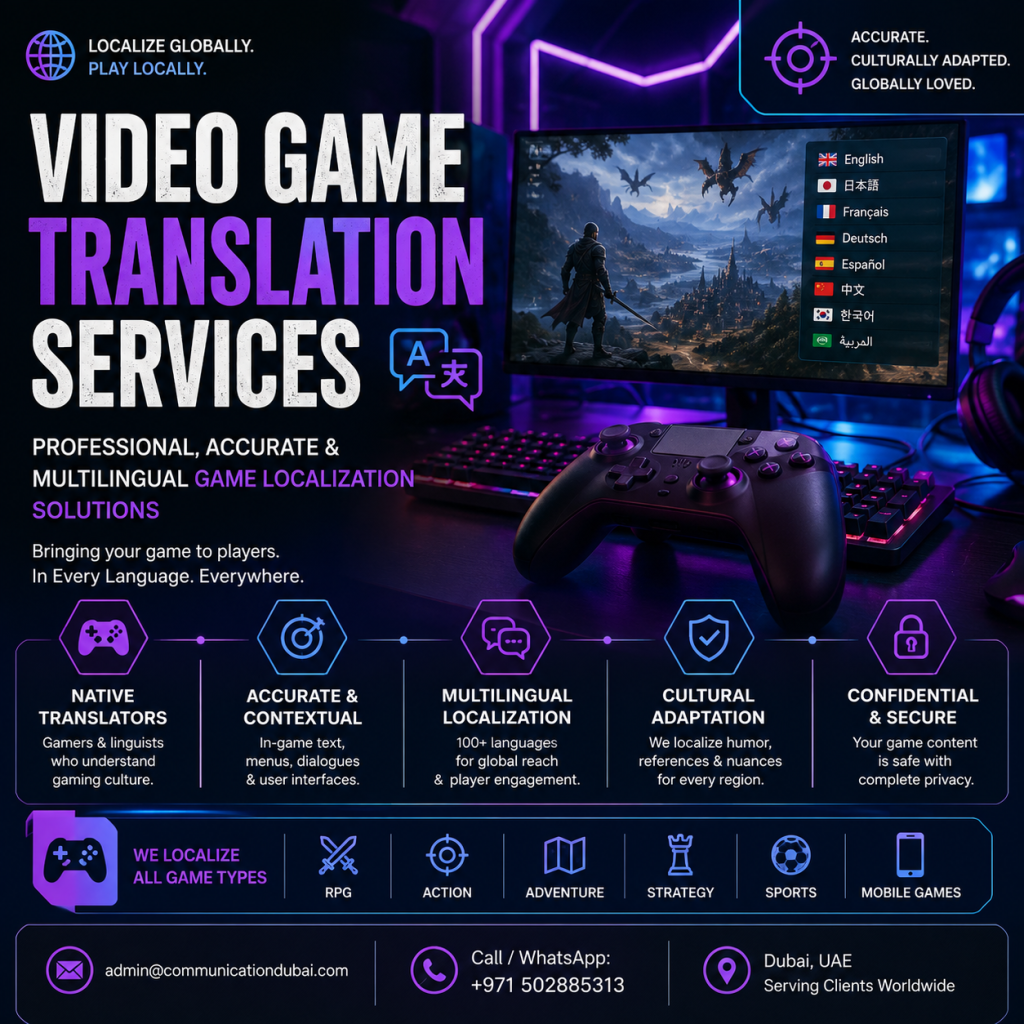
Video Game Translation Services
Video Game Translation Services – Professional, Accurate & Multilingual Game Localization Solutions
The global video game industry reaches players across many countries, cultures, platforms, and languages. A game that performs well in one market may still struggle internationally if menus, dialogue, tutorials, subtitles, item names, store descriptions, or player instructions are not localized naturally.
Professional Video Game Translation Services help game developers, publishers, studios, localization teams, mobile app companies, indie developers, and gaming platforms adapt games for international audiences while preserving gameplay meaning, character personality, story, humor, terminology, and user experience.
At Communication Legal Translation, we provide professional multilingual language solutions across more than 75 languages. Our game translation and localization services can support PC games, console games, mobile games, online games, educational games, simulation titles, AR/VR experiences, and gaming-related marketing content.
Whether you require English-to-Arabic game translation, Arabic-to-English game localization, Japanese game translation, Chinese game localization, French translation, German translation, Spanish translation, subtitle localization, UI translation, or multilingual video game localization, each project can be reviewed according to the game genre, platform, target market, terminology, content volume, file format, and deadline.
What Are Video Game Translation Services?
Video game translation involves translating written and spoken game content from one language into another.
Content can include:
- User Interface
- Menus
- Dialogue
- Subtitles
- Character Names
- Item Descriptions
- Quests
- Tutorials
- Achievement Text
- System Messages
- Store Content
- Marketing Materials
- Help Content
- Player Support
Professional game localization goes further by adapting the content to make it natural for players in the target market.
Video Game Translation vs Game Localization
Translation focuses primarily on converting text from one language into another.
Localization can also consider:
- Cultural References
- Humor
- Character Voice
- Date Formats
- Currency
- Measurements
- UI Space
- Player Expectations
- Age Rating Language
- Regional Terminology
A localized game should feel natural to players rather than simply translated.
Why Professional Game Localization Matters
Games depend heavily on player experience.
Poor localization can create:
- Confusing Instructions
- Awkward Dialogue
- Incorrect Item Names
- Broken Humor
- Inconsistent Terminology
- UI Overflow
- Misleading Quests
- Unnatural Character Speech
Professional localization helps preserve immersion while making the game easier to understand.
Video Game Translation Services in Dubai
Dubai and the wider UAE have a growing gaming, esports, technology, entertainment, and mobile-app ecosystem.
Game localization can support studios and companies targeting:
- UAE Players
- GCC Markets
- Middle East
- Europe
- Asia
- North America
- International Gaming Communities
Arabic localization can be particularly important for companies targeting players in the Gulf and wider Middle East.
Arabic Video Game Translation
Arabic game localization can support:
- PC Games
- Console Games
- Mobile Games
- Online Games
- Educational Games
- Simulation Games
- Gaming Platforms
Arabic localization may also require consideration of right-to-left interface design.
English to Arabic Game Translation
English-to-Arabic game translation can include:
- Dialogue
- Menus
- Tutorials
- Quest Text
- System Messages
- Item Descriptions
- Store Content
- Subtitles
The Arabic should sound natural and appropriate to the intended audience.
Arabic to English Game Translation
Arabic game content may require English localization for international markets.
Translation can support:
- Dialogue
- Story Content
- UI
- Game Instructions
- Character Descriptions
- Marketing Materials
The English version should preserve the original tone and gameplay meaning.
Multilingual Game Localization
A single game may require localization into several languages.
For example:
- Arabic
- English
- French
- German
- Spanish
- Italian
- Portuguese
- Japanese
- Korean
- Chinese
- Russian
- Turkish
A centralized workflow can help maintain terminology and character consistency.
Game UI Translation
User-interface translation can include:
- Main Menu
- Settings
- Inventory
- Map Labels
- Buttons
- Notifications
- Status Messages
- Player Profiles
- Save & Load Screens
UI text often has strict character limits, so concise localization is important.
Menu Translation
Game menus may contain short strings such as:
- Start
- Continue
- Options
- Multiplayer
- Settings
- Exit
- Load
- Save
These strings should be translated according to context rather than in isolation.
Game Dialogue Translation
Dialogue localization is one of the most creative parts of game translation.
Dialogue can include:
- Main Characters
- NPCs
- Cutscenes
- Villains
- Side Characters
- Story Events
- Random Conversations
Each character should maintain a consistent personality and tone.
Character Voice Localization
Different characters may speak in different styles.
These can include:
- Formal
- Casual
- Humorous
- Aggressive
- Mysterious
- Childlike
- Historical
- Futuristic
The localized dialogue should preserve these distinctions.
NPC Dialogue Translation
NPC dialogue can include:
- Quest Instructions
- Hints
- Background Story
- Greetings
- Reactions
- Warnings
- Ambient Dialogue
Terminology should remain consistent across repeated interactions.
Game Story Translation
Story-driven games may contain large amounts of narrative content.
Translation can support:
- Main Story
- Side Stories
- Lore
- Cutscenes
- Character Backgrounds
- World History
- In-Game Books
- Letters
Narrative style should remain engaging in the target language.
Game Script Translation
Game scripts can include:
- Dialogue
- Voice-Over Lines
- Cutscene Scripts
- Narration
- Character Reactions
- Cinematic Content
Localization should consider context, timing, and character identity.
Subtitle Translation for Video Games
Game subtitles may be required for:
- Cutscenes
- Character Dialogue
- Cinematics
- Narration
- Tutorials
- Story Content
Subtitle localization should consider:
- Timing
- Readability
- Character Length
- Tone
- Visual Context
Voice-Over Script Translation
Voice-over localization can support:
- Character Dialogue
- Narration
- Tutorials
- Cinematics
- In-Game Announcements
The translated script should sound natural when spoken aloud.
Game Dubbing Script Localization
Dubbing may require additional adaptation for:
- Timing
- Lip Movement
- Scene Duration
- Character Emotion
- Speaking Speed
The translated line may therefore differ slightly from a literal translation while preserving meaning.
Quest Translation Services
Quest content can include:
- Quest Titles
- Objectives
- Instructions
- Rewards
- Dialogue
- Completion Messages
- Failure Messages
Clear wording is important so players understand what to do.
Mission Translation
Mission-based games can require localization of:
- Mission Names
- Mission Objectives
- Mission Briefings
- Rewards
- Success Messages
- Failure Messages
Terminology should remain consistent across missions.
Tutorial Translation
Tutorial localization can include:
- Controls
- Gameplay Instructions
- Interface Explanations
- Skill Information
- Tips
- Training Missions
Tutorial text should be simple and easy to follow.
Game Controls Translation
Control instructions may include:
- Move
- Jump
- Attack
- Block
- Interact
- Open Map
- Switch Weapon
- Pause
Translations should match the actual interface and control system.
Item Description Translation
Games often contain hundreds or thousands of items.
These can include:
- Weapons
- Armor
- Potions
- Tools
- Materials
- Collectibles
- Consumables
- Quest Items
Item names and descriptions should remain consistent.
Weapon Translation
Weapon-related text can include:
- Weapon Names
- Damage
- Attributes
- Special Effects
- Upgrade Information
- Descriptions
The localized terminology should fit the game’s genre and tone.
Armor & Equipment Translation
Equipment localization may include:
- Armor Sets
- Accessories
- Shields
- Helmets
- Boots
- Gloves
- Stats
- Bonuses
Consistent naming can help players understand equipment systems.
Skill & Ability Translation
Skills may contain:
- Skill Names
- Effects
- Cooldowns
- Damage Information
- Upgrade Requirements
- Status Effects
Gameplay meaning should remain precise.
Character Class Translation
Games may contain character classes such as:
- Warrior
- Mage
- Archer
- Healer
- Assassin
- Tank
- Support
Class terminology should remain consistent across UI, tutorials, skill descriptions, and marketing.
Achievement Translation
Achievements and trophies may include:
- Titles
- Requirements
- Descriptions
- Rewards
Some achievement names involve jokes or cultural references that may require creative localization.
Game Notification Translation
Notifications can include:
- Level Up
- Quest Completed
- Item Received
- Achievement Unlocked
- Connection Lost
- Match Found
- Error Messages
Short, clear wording is important.
Error Message Translation
Error messages can include:
- Connection Errors
- Login Problems
- Server Issues
- Save Errors
- Purchase Failures
- Installation Problems
The localized message should help players understand what happened.
Multiplayer Game Translation
Multiplayer games may require localization for:
- Matchmaking
- Player Profiles
- Lobbies
- Teams
- Rankings
- Chat
- Notifications
- Competitive Modes
Terminology should remain consistent across all multiplayer systems.
Online Game Localization
Online games may receive frequent updates.
Localization can support:
- New Characters
- Events
- Patches
- Seasonal Content
- New Items
- Quests
- Promotions
- System Updates
An ongoing localization workflow can help translated content stay current.
Mobile Game Translation
Mobile games often contain:
- UI
- Tutorials
- Push Notifications
- In-App Purchases
- Events
- Ads
- Store Listings
- Character Dialogue
Mobile interfaces usually require concise text.
iOS Game Localization
iOS game localization can support:
- Interface
- Notifications
- App Store Content
- Tutorials
- Game Text
- Purchase Information
The localized text should fit mobile screen constraints.
Android Game Localization
Android localization can support:
- UI
- Gameplay Content
- Tutorials
- Store Listings
- Notifications
- Customer Support
- Events
Localization should be tested across different screen sizes where possible.
Console Game Translation
Console games may require localization for:
- PlayStation
- Xbox
- Nintendo Platforms
- Other Console Systems
Content can include:
- UI
- Dialogue
- Tutorials
- Achievements
- Store Information
- System Messages
PC Game Translation
PC games may include:
- Menus
- Keyboard Controls
- Mods-related Content
- Multiplayer Systems
- Tutorials
- Story Dialogue
- Settings
The localized UI should account for different screen resolutions.
Indie Game Translation Services
Independent developers may require localization with smaller teams and budgets.
Translation can support:
- Dialogue
- UI
- Store Pages
- Tutorials
- Marketing
- Subtitles
Even smaller games benefit from terminology consistency.
AAA Game Localization
Large games may contain hundreds of thousands or millions of words.
AAA localization can involve:
- Story Content
- Dialogue
- Quests
- Item Databases
- Tutorials
- UI
- Subtitles
- Marketing
Large projects usually require structured terminology and project management.
RPG Translation Services
Role-playing games often contain extensive narrative and terminology.
Content can include:
- Character Dialogue
- Quests
- Skills
- Items
- Lore
- Character Classes
- World Building
Consistency is especially important in long RPG projects.
MMORPG Translation Services
Massively multiplayer online games may require continuous localization for:
- Characters
- Quests
- Events
- Items
- Raids
- Guild Systems
- Seasonal Updates
- Player Communication
Large terminology databases can help maintain consistency.
Action Game Translation
Action games may require translation for:
- Missions
- Combat Instructions
- Weapons
- Skills
- UI
- Story Content
Short, clear gameplay text is important.
Adventure Game Localization
Adventure games may contain:
- Story Dialogue
- Puzzles
- Items
- Clues
- Character Conversations
- Lore
The translated narrative should remain immersive.
Strategy Game Translation
Strategy games can include complex terminology related to:
- Units
- Resources
- Buildings
- Technology
- Diplomacy
- Combat
- Economy
Terminology consistency helps players understand game systems.
Simulation Game Translation
Simulation games can involve specialized terminology relating to:
- Vehicles
- Cities
- Business
- Farming
- Aviation
- Construction
- Sports
Subject-specific knowledge may be important.
Sports Game Translation
Sports games can require localization for:
- Player Positions
- Match Rules
- Statistics
- Commentary
- Menus
- Career Modes
- Tournaments
Sports terminology should match common usage in the target market.
Racing Game Translation
Racing games may include:
- Vehicle Information
- Track Names
- Car Setup
- Performance Statistics
- Race Modes
- Tutorials
Automotive terminology may require specialist knowledge.
Educational Game Translation
Educational games may require localization for:
- Instructions
- Lessons
- Activities
- Quizzes
- Feedback
- Narration
The language should match the age and educational level of the player.
Children’s Game Localization
Games for children require special attention to:
- Simplicity
- Age-Appropriate Language
- Safety
- Humor
- Instructions
- Readability
The localized language should remain easy to understand.
Horror Game Translation
Horror games often depend heavily on atmosphere and narrative.
Translation can support:
- Dialogue
- Notes
- Lore
- Warnings
- Item Descriptions
- Story Content
Tone should preserve suspense and emotional impact.
Fantasy Game Translation
Fantasy games may contain:
- Invented Names
- Magic Systems
- Creatures
- Locations
- Lore
- Weapons
- Spells
A terminology glossary can help maintain consistency across the fictional world.
Science Fiction Game Translation
Sci-fi games may combine:
- Fictional Terminology
- Technology
- Space Travel
- Weapons
- Artificial Intelligence
- Scientific Concepts
The localized language should preserve both clarity and world-building.
Historical Game Translation
Historical games may include:
- Historical Figures
- Locations
- Events
- Military Terminology
- Period Dialogue
- Cultural References
Translation should consider historical context.
Game Localization for Arabic Markets
Arabic localization can help developers reach players across:
- UAE
- Saudi Arabia
- Qatar
- Kuwait
- Bahrain
- Oman
- Wider Middle East & North Africa
Localization can include language, interface direction, cultural considerations, and marketing.
RTL Game Localization
Arabic uses a right-to-left writing system.
Game localization may therefore require attention to:
- Menu Alignment
- Text Boxes
- Navigation
- Numbers
- Mixed Arabic-English Content
- Icons
- UI Mirroring
Translation quality alone may not be enough if the interface does not support RTL properly.
Game Localization for Japanese Market
Japanese localization can support:
- Dialogue
- UI
- Tutorials
- Store Content
- Marketing
- Subtitles
The appropriate level of formality and character voice should be considered.
Chinese Game Localization
Chinese game localization can support:
- Simplified Chinese
- Traditional Chinese
The correct written-language form should be selected according to the target market.
Korean Game Localization
Korean localization can support:
- UI
- Story
- Dialogue
- Tutorials
- Marketing
- Store Listings
Character tone and levels of politeness may require careful adaptation.
French Game Localization
French localization can support:
- France
- Canada
- Belgium
- Switzerland
- Other French-speaking Markets
Regional preferences should be considered where relevant.
German Game Localization
German localization can support:
- UI
- Dialogue
- Game Instructions
- Marketing
- Store Content
- Subtitles
German text can be longer than English, so UI space may require attention.
Spanish Game Localization
Spanish game localization may target:
- Spain
- Mexico
- Latin America
- US Spanish-speaking Audiences
The intended market should ideally be identified before localization.
Portuguese Game Localization
Portuguese localization should distinguish between:
- Brazilian Portuguese
- European Portuguese
The two markets can differ significantly in vocabulary and style.
Russian Game Localization
Russian localization may support:
- UI
- Dialogue
- Story
- Tutorials
- Marketing
- Multiplayer Content
Cyrillic support should be tested in the game interface.
Turkish Game Localization
Turkish localization can support:
- Game UI
- Dialogue
- Tutorials
- Marketing
- Store Listings
- Player Support
Localization should use natural gaming terminology.
Game Store Listing Translation
Store-page localization can support:
- Steam
- Console Stores
- Mobile App Stores
- Publisher Websites
- Gaming Platforms
Content can include:
- Game Title
- Short Description
- Full Description
- Features
- Update Notes
- Promotional Text
Steam Game Translation
Steam localization can include:
- Store Page
- Game Description
- UI
- Achievements
- Updates
- Community Content
A localized store page can help international players understand the game before purchasing.
App Store Game Localization
Mobile game store localization can support:
- App Name
- Subtitle
- Description
- Keywords
- Promotional Text
- Update Notes
Character limits should be considered.
Game Marketing Translation
Game marketing can include:
- Trailers
- Social Media
- Advertisements
- Websites
- Press Releases
- Email Campaigns
- Promotional Artwork
Marketing localization should preserve the energy and tone of the game.
Game Trailer Subtitle Translation
Trailers often contain:
- Dialogue
- Narration
- Promotional Headlines
- Calls to Action
Subtitle translation should remain concise and impactful.
Gaming Social Media Translation
Gaming brands may need localization for:
- TikTok
- YouTube
- X
- Discord-related Content
Tone may be more casual and community-focused than other business translation.
Game Press Release Translation
Press releases can support:
- Game Announcements
- Launches
- Updates
- Partnerships
- Events
- Esports News
The translated content should remain professional and engaging.
Esports Translation Services
Esports localization can support:
- Tournament Information
- Player Profiles
- Rules
- Event Websites
- Promotional Materials
- Livestream Content
- Social Media
Gaming terminology should remain natural to esports audiences.
Gaming Website Translation
Game developers and publishers may require multilingual websites.
Content can include:
- Game Pages
- News
- Support
- Community Information
- Download Pages
- FAQs
- Store Content
Terminology should match the actual game.
Player Support Translation
Customer-support content can include:
- Help Centers
- FAQs
- Troubleshooting
- Account Support
- Payment Help
- Technical Support
Clear localization can reduce player frustration.
Gaming FAQ Translation
FAQs can cover:
- Installation
- Accounts
- Controls
- Multiplayer
- Purchases
- Technical Problems
- Updates
The translated answers should remain simple and practical.
Game Patch Note Translation
Patch notes can include:
- Bug Fixes
- New Features
- Balance Changes
- Character Updates
- New Content
- Performance Improvements
Terminology should match existing game translations.
Live Service Game Localization
Live-service games may receive weekly or monthly content updates.
Translation can support:
- Seasonal Events
- Battle Passes
- New Characters
- New Items
- Patch Notes
- Promotions
Fast, consistent localization can be especially important.
Game Localization Testing
Translation can look correct in a spreadsheet but still create problems inside the game.
Localization testing can check:
- Text Overflow
- Truncated Strings
- Wrong Context
- Missing Characters
- UI Alignment
- RTL Display
- Subtitle Timing
- Incorrect Terminology
Testing helps identify issues before release.
Linguistic Quality Assurance for Games
Linguistic QA can review:
- Grammar
- Context
- Character Voice
- Terminology
- Spelling
- UI Fit
- Consistency
- Subtitle Readability
In-game context is particularly important.
Game Terminology Management
Large games can contain thousands of repeated terms.
A terminology glossary may include:
- Character Names
- Locations
- Weapons
- Skills
- Items
- Factions
- Game Modes
- Technical Terms
Approved terminology helps maintain consistency.
Game Style Guide
A game localization style guide can define:
- Character Tone
- Capitalization
- Punctuation
- Formality
- Naming Rules
- Humor Style
- Treatment of Invented Terms
This can help multiple translators produce consistent content.
Translation Memory for Video Games
Translation-memory tools can help manage repeated strings.
They can be useful for:
- UI
- System Messages
- Tutorials
- Updates
- Recurring Events
Human review remains important because identical strings can have different meanings in different contexts.
Localization File Translation
Game text may be supplied in formats such as:
- Excel
- CSV
- JSON
- XML
- XLIFF
- Text Files
- Localization Platforms
Translators should avoid changing code, tags, placeholders, or variables unintentionally.
Placeholder & Variable Protection
Game text may contain elements such as:
- {player_name}
- %s
- %d
- HTML Tags
- Game Codes
- Variables
These elements should generally remain intact during translation.
Game Localization for Multiple Platforms
One game may launch on:
- PC
- Console
- Mobile
- Cloud Gaming
Platform-specific terminology may vary.
Localization should account for the actual platform where relevant.
Online Video Game Translation Services
Game localization projects can often be coordinated digitally.
Clients may provide:
- Localization Files
- Scripts
- Spreadsheets
- Screenshots
- Video References
- Builds
- Style Guides
- Glossaries
Contextual materials can significantly improve translation quality.
Urgent Game Translation Services
Urgent localization may be required for:
- Game Launches
- Patches
- Seasonal Events
- Marketing Campaigns
- Store Updates
- Esports Events
Availability depends on:
- Language Pair
- Word Count
- Number of Languages
- File Format
- Complexity
- Deadline
Confidential Video Game Translation
Game projects often contain confidential information before release.
This can include:
- Unannounced Titles
- Story Content
- New Characters
- Game Mechanics
- Launch Plans
- Marketing Campaigns
- Internal Builds
At Communication Legal Translation, we understand the importance of appropriate confidentiality when handling unreleased gaming content.
Human Game Translation vs Machine Translation
Machine translation can help with basic understanding, but game localization often depends on creativity and context.
Human translation is especially valuable for:
- Dialogue
- Humor
- Character Voice
- Story Content
- Quests
- Marketing
- Cultural Adaptation
Games are interactive experiences, so isolated machine-translated strings can easily feel unnatural.
Who Needs Video Game Translation Services?
Professional game localization can support:
- Game Developers
- Game Publishers
- Indie Studios
- Mobile Game Companies
- Console Developers
- PC Game Studios
- Esports Organizations
- Gaming Platforms
- Educational Game Developers
- AR/VR Companies
- Marketing Agencies
Whether you need one mobile game translated into Arabic, a story-driven game localized into several languages, or a large multilingual live-service project, professional game localization can help create a more natural experience for international players.
Our Professional Video Game Localization Process
Professional Video Game Translation Services require a structured workflow because game content can include dialogue, user interfaces, quests, subtitles, item descriptions, tutorials, system messages, store pages, marketing materials, and live-service updates.
At Communication Legal Translation, each game localization project can be reviewed according to the source language, target language, game genre, platform, target market, content volume, file format, terminology, testing requirements, and deadline.
A clear localization process helps maintain consistency across gameplay, narrative, character voice, UI, subtitles, and marketing content.
Step 1: Submit the Game Content
The localization process begins with the available source material.
Clients may provide:
- Localization Files
- Excel Spreadsheets
- CSV Files
- JSON Files
- XML Files
- XLIFF Files
- Dialogue Scripts
- Subtitle Files
- Screenshots
- Gameplay Videos
- Builds
- Style Guides
- Existing Glossaries
The more context provided, the easier it is to avoid ambiguous or incorrect translations.
Step 2: Confirm the Target Languages
Game localization may involve:
- English to Arabic
- Arabic to English
- English to French
- English to German
- English to Spanish
- English to Portuguese
- English to Japanese
- English to Korean
- English to Chinese
- English to Russian
- English to Turkish
Large games may require several languages at the same time.
Step 3: Identify the Game Genre
Game genre affects terminology, writing style, and player expectations.
Localization may be required for:
- RPG
- MMORPG
- Action
- Adventure
- Strategy
- Simulation
- Racing
- Sports
- Horror
- Fantasy
- Science Fiction
- Educational Games
- Children’s Games
A fantasy RPG and a realistic racing simulator should not be translated using the same style.
Step 4: Identify the Target Market
Localization should consider where the game will be released.
Possible target markets can include:
- Middle East
- UAE
- Saudi Arabia
- North America
- Europe
- Japan
- South Korea
- China
- Latin America
- Brazil
- Turkey
Different markets may require different terminology, cultural adaptation, and language variants.
Step 5: Create a Game Terminology Glossary
A project glossary can include:
- Character Names
- Locations
- Factions
- Weapons
- Armor
- Skills
- Items
- Game Modes
- Quest Terminology
- Technical Terms
- System Messages
Approved terminology helps keep the game consistent across thousands of strings.
Step 6: Build a Localization Style Guide
A style guide can define how the game should sound.
It may cover:
- Character Voice
- Formality
- Humor
- Capitalization
- Punctuation
- Naming Rules
- Treatment of Invented Terms
- Abbreviations
- Profanity Level
- Tone
This is particularly useful when several translators work on the same title.
Step 7: Professional Human Translation
During translation, careful attention can be given to:
- Gameplay Meaning
- Context
- Character Personality
- Terminology
- Tone
- Humor
- UI Length
- Placeholders
- Variables
- Tags
- Player Instructions
The translated game text should feel natural to the target player.
Step 8: Protect Variables, Tags & Code
Game localization files often contain technical elements.
These may include:
- {player_name}
- {item_count}
- %s
- %d
- HTML Tags
- XML Tags
- Control Codes
- Game Variables
- Formatting Codes
These should not be translated or altered unless specifically required.
Step 9: Editing & Linguistic Review
Depending on project requirements, translated game content can undergo additional review.
Checks may include:
- Translation Accuracy
- Grammar
- Terminology
- Character Voice
- Readability
- UI Length
- Consistency
- Missing Strings
- Placeholder Accuracy
Narrative-heavy games may require additional creative review.
Step 10: In-Game Linguistic Quality Assurance
Some localization problems only become visible inside the game.
Linguistic QA can check:
- Text Overflow
- Truncated Text
- Wrong Context
- Missing Characters
- Broken Tags
- Incorrect Line Breaks
- Wrong Terminology
- Subtitle Timing
- RTL Problems
- UI Alignment
Testing helps improve the final player experience.
UI Localization Workflow
Game UI localization requires particular attention because screen space is limited.
UI content can include:
- Menus
- Buttons
- Settings
- Notifications
- Inventory
- Character Screens
- Maps
- Player Profiles
- Store Interfaces
Translated strings should remain concise while preserving meaning.
Menu Translation Quality Control
Menu text can appear in multiple places.
A single term such as “Continue” might refer to:
- Continue Game
- Continue Dialogue
- Continue Purchase
- Continue Setup
Context should be provided where possible.
Dialogue Localization Workflow
Dialogue localization is often highly creative.
The process can include:
- Character Analysis
- Story Context Review
- Terminology Preparation
- Translation
- Character Voice Review
- Editing
- In-Game Testing
This helps maintain personality and emotional consistency.
Character Voice Consistency
Each character may have a unique speaking style.
For example:
- Heroic
- Sarcastic
- Formal
- Childlike
- Aggressive
- Comic
- Mysterious
- Ancient
- Futuristic
The same voice should be maintained throughout the game.
Humor Localization
Humor often cannot be translated literally.
Game humor may involve:
- Wordplay
- Puns
- Memes
- Cultural References
- Sarcasm
- Character Jokes
Creative adaptation may be needed to preserve the intended effect.
Quest Localization Workflow
Quest localization can include:
- Quest Title
- Objective
- Description
- Dialogue
- Rewards
- Completion Message
- Failure Message
The wording should clearly tell players what they need to do.
Mission Localization
Mission text can include:
- Briefings
- Objectives
- Checkpoints
- Success Conditions
- Failure Conditions
Clear gameplay instructions are essential.
Tutorial Localization
Tutorials should be simple and direct.
Translation can support:
- Controls
- Movement
- Combat
- Inventory
- Crafting
- Skills
- Menus
- Game Systems
Tutorial language should match the player’s skill level.
Item Database Localization
Large games may contain thousands of items.
Localization can include:
- Item Names
- Descriptions
- Stats
- Rarity
- Effects
- Requirements
- Upgrade Information
A terminology glossary is useful for maintaining consistency.
Skill & Ability Localization
Skill descriptions often contain important gameplay information.
Translation can include:
- Damage
- Cooldown
- Range
- Status Effects
- Duration
- Resource Cost
- Upgrade Effects
The translated wording should preserve gameplay meaning precisely.
Game Economy Translation
Games may include terminology relating to:
- Currency
- Coins
- Gems
- Credits
- Rewards
- Pricing
- Purchases
- Trading
In-game currencies should remain consistent across UI, tutorials, and store pages.
Achievement & Trophy Localization
Achievements may require both accurate and creative translation.
Content can include:
- Titles
- Descriptions
- Unlock Conditions
- Rewards
Humorous achievement names may require transcreation.
Subtitle Localization Workflow
Game subtitles should balance readability and timing.
The workflow may consider:
- Character Length
- Reading Speed
- Scene Timing
- Speaker
- Dialogue Context
- Line Breaks
Subtitles should remain natural while fitting the available screen time.
Voice-Over Script Localization
Voice-over scripts can support:
- Character Dialogue
- Narration
- Tutorials
- Announcements
- Cinematics
- Marketing Trailers
The translated script should sound natural when spoken aloud.
Dubbing Adaptation
Dubbing may require additional adaptation to match:
- Scene Timing
- Lip Movement
- Character Emotion
- Speaking Speed
- Performance Length
The translated line may need to be shorter or longer while keeping the original meaning.
Voice-Over Recording Support
Where required, localized scripts can be prepared for professional voice recording.
Preparation may include:
- Speaker Labels
- Pronunciation Notes
- Timing
- Emotional Direction
- Character Notes
Clear scripts help voice actors perform more naturally.
Arabic Game Localization Workflow
Arabic localization can involve both linguistic and technical challenges.
Projects may require:
- Arabic Translation
- RTL UI Support
- Text Alignment
- Numeral Handling
- Mixed Arabic-English Text
- Font Compatibility
- UI Testing
Arabic text should be reviewed inside the actual game environment whenever possible.
Arabic RTL Testing
RTL testing can check:
- Menu Direction
- Text Alignment
- Button Placement
- Number Order
- Mixed Scripts
- Icons
- Chat Windows
- Inventory Layout
A correct Arabic translation can still create a poor player experience if the UI does not support RTL properly.
Arabic Gaming Terminology
Arabic gaming terminology may involve decisions about whether to:
- Translate a Term
- Transliterate It
- Keep the English Term
- Use a Common Gaming Equivalent
The chosen terminology should remain consistent throughout the game.
English to Arabic Game Localization
English-to-Arabic localization can support:
- Dialogue
- UI
- Tutorials
- Quests
- Subtitles
- Store Pages
- Player Support
- Marketing
The Arabic should feel natural to players rather than overly formal unless the game’s style requires it.
Arabic to English Game Localization
Arabic games targeting international audiences may require English localization of:
- Story
- Dialogue
- Game Systems
- UI
- Marketing
- Support Content
The English version should preserve the tone and cultural identity of the original game.
Japanese Game Localization
Japanese localization can require careful handling of:
- Formality
- Character Voice
- Honorifics
- UI Length
- Gaming Terminology
- Cultural Context
Dialogue-heavy games may require extensive creative adaptation.
Chinese Game Localization
Chinese localization may target:
- Simplified Chinese
- Traditional Chinese
The required form should be confirmed according to the intended market.
Localization can support:
- UI
- Dialogue
- Tutorials
- Quests
- Marketing
- Store Pages
Korean Game Localization
Korean game localization can require careful handling of:
- Formality Levels
- Character Relationships
- Dialogue Style
- UI Length
- Gaming Terminology
The localized version should feel natural to Korean players.
French Game Localization
French localization can support:
- France
- Canada
- Belgium
- Switzerland
The intended target market should be identified where regional differences matter.
German Game Localization
German text can often be longer than English.
UI localization may therefore require attention to:
- Button Width
- Menu Space
- Dialogue Boxes
- Text Wrapping
Concise phrasing may be needed.
Spanish Game Localization
Spanish localization should identify the intended target market.
Possible variants can include:
- Spain
- Latin American Spanish
- Mexican Spanish
- US Spanish
Terminology can vary significantly across markets.
Portuguese Game Localization
Portuguese localization should normally distinguish between:
- Brazilian Portuguese
- European Portuguese
Vocabulary, tone, and gaming terminology can differ.
Russian Game Localization
Russian localization may require:
- Cyrillic Font Support
- UI Testing
- Grammar Adaptation
- Terminology Management
Text expansion should also be considered.
Turkish Game Localization
Turkish game localization can support:
- Dialogue
- UI
- Tutorials
- Quest Content
- Marketing
- Store Listings
Natural gaming terminology helps improve player experience.
PC Game Localization
PC localization can include:
- Keyboard Controls
- Graphics Settings
- Multiplayer
- Mods-related Content
- Dialogue
- UI
- Store Information
Terminology should match the actual controls and platform.
Console Game Localization
Console localization can support:
- PlayStation
- Xbox
- Nintendo
- Other Console Platforms
Platform-specific terms such as button names should follow the relevant platform conventions.
Mobile Game Localization
Mobile game localization may involve tight space limitations.
Content can include:
- Menus
- Notifications
- Tutorials
- In-App Purchases
- Events
- Ads
- Push Notifications
- App Store Content
Concise localization is especially important.
VR & AR Game Localization
Virtual and augmented reality projects may require localization for:
- Interactive Instructions
- Spatial UI
- Tutorials
- Safety Content
- Menus
- Voice Guidance
Text should remain readable and comfortable in immersive environments.
Indie Game Localization
Indie studios may require localization for:
- Game Text
- UI
- Store Pages
- Dialogue
- Tutorials
- Marketing
A smaller budget does not remove the need for consistent terminology.
AAA Game Localization
Large AAA projects may include:
- Hundreds of Thousands of Words
- Thousands of Voice Lines
- Extensive Lore
- Quests
- Item Databases
- UI
- Marketing
- Live Updates
These projects can require multiple translators, editors, testers, and terminology resources.
RPG Localization
RPG games often require strong consistency because the player may spend dozens or hundreds of hours in the same fictional world.
Localization can support:
- Character Classes
- Skills
- Quests
- Items
- Lore
- Dialogue
- Factions
- Locations
A detailed glossary can be especially valuable.
MMORPG Localization
MMORPGs often require long-term localization support.
Content may include:
- New Expansions
- Characters
- Raids
- Quests
- Events
- Items
- Guild Systems
- Patch Notes
Terminology should remain consistent over years of updates.
Strategy Game Localization
Strategy games can contain complex terminology relating to:
- Units
- Resources
- Economy
- Buildings
- Technology
- Diplomacy
- Combat
Consistent terminology helps players understand systems more quickly.
Sports Game Localization
Sports games may require translation of:
- Rules
- Player Positions
- Statistics
- Commentary
- Tournaments
- Career Modes
- Menus
Sports terminology should match what players commonly use in the target market.
Racing Game Localization
Racing games may include automotive terminology such as:
- Horsepower
- Torque
- Suspension
- Tire Pressure
- Transmission
- Braking
- Vehicle Setup
Specialist automotive knowledge may be useful.
Historical Game Localization
Historical games may require translation of:
- Period Dialogue
- Historical Events
- Military Terminology
- Locations
- Political Titles
- Cultural References
The localized text should balance historical tone and modern readability.
Fantasy Game Localization
Fantasy games often contain invented terminology.
This can include:
- Spells
- Creatures
- Kingdoms
- Gods
- Weapons
- Factions
- Races
A terminology database can help prevent inconsistent translations.
Science Fiction Game Localization
Science-fiction games may contain:
- Fictional Technology
- AI Terminology
- Space Travel
- Scientific Concepts
- Alien Races
- Weapons
- Organizations
World-building terminology should remain consistent.
Horror Game Localization
Horror localization should preserve:
- Suspense
- Fear
- Mystery
- Psychological Tone
- Environmental Storytelling
Literal translation can reduce emotional impact.
Children’s Game Localization
Children’s games require particular attention to:
- Simple Language
- Readability
- Age Appropriateness
- Safety
- Humor
- Instructions
The localization should be easy for the intended age group to understand.
Educational Game Localization
Educational games may require translation of:
- Lessons
- Instructions
- Exercises
- Quizzes
- Feedback
- Learning Goals
The translated language should match the educational level.
Game Store Page Localization
Game store pages are important because they often influence whether a player downloads or buys a game.
Localization can include:
- Game Title
- Short Description
- Long Description
- Key Features
- System Requirements
- Promotional Copy
- Update Notes
Marketing language should remain persuasive and accurate.
Steam Localization
Steam localization can support:
- Store Page
- Game Description
- Achievements
- Patch Notes
- Community Updates
- DLC Information
Terminology should match the in-game translation.
Mobile App Store Localization
Mobile store localization can include:
- App Name
- Subtitle
- Description
- Promotional Text
- Keywords
- Update Notes
Character limits should be respected.
Game Marketing Localization
Game marketing can support:
- Websites
- Social Media
- Trailers
- Advertising
- Email Campaigns
- Press Releases
- Influencer Materials
The localized copy should preserve the energy and personality of the game.
Game Trailer Translation
Game trailers may contain:
- Dialogue
- Narration
- Headlines
- Calls to Action
- Release Information
The translation should remain concise and impactful.
Gaming Social Media Localization
Gaming brands may require localized content for:
- TikTok
- YouTube
- X
- Discord-related Communication
Gaming communities often respond better to natural, conversational language.
Game Press Release Translation
Press releases can announce:
- New Games
- Launch Dates
- DLC
- Partnerships
- Esports Events
- Major Updates
The target-language version should remain professional while preserving excitement.
Esports Translation Services
Esports localization can support:
- Tournament Rules
- Event Information
- Player Profiles
- Livestream Graphics
- Commentary Scripts
- Social Media
- Promotional Materials
Terminology should match the esports community.
Player Support Translation
Player-support content can include:
- Help Centers
- FAQs
- Account Assistance
- Payment Support
- Troubleshooting
- Technical Support
- Refund Guidance
Clear translation can help reduce frustration and support tickets.
Game FAQ Localization
FAQs can cover:
- Installation
- Accounts
- Multiplayer
- Controls
- Purchases
- Connectivity
- Updates
Answers should remain concise and practical.
Patch Note Translation
Patch notes can include:
- Bug Fixes
- Balance Changes
- New Characters
- New Items
- Performance Improvements
- Gameplay Changes
Existing game terminology should be reused consistently.
Live-Service Localization
Live-service games may require continuous translation for:
- Events
- Seasons
- Battle Passes
- New Characters
- New Maps
- New Items
- Promotions
- Patch Notes
A fast and consistent workflow is especially important for simultaneous global releases.
Localization for DLC & Expansions
Downloadable content and expansions can require translation of:
- New Stories
- Characters
- Quests
- Items
- Locations
- Marketing Materials
The localization should remain consistent with the original game.
Continuous Game Localization
Games can evolve for years after launch.
Ongoing localization can help manage:
- Weekly Updates
- Monthly Events
- Seasonal Content
- New Languages
- Bug Fixes
- Community Updates
Maintaining a long-term glossary can improve consistency.
Localization Testing Workflow
Testing may include:
- Build Review
- Language Selection Check
- UI Review
- Dialogue Review
- Subtitle Testing
- Gameplay Terminology Check
- Bug Reporting
- Retest
This helps identify issues that are invisible in translation files alone.
Linguistic QA Bug Categories
Localization issues can include:
- Mistranslation
- Grammar Error
- Truncation
- Overflow
- Wrong Gender
- Wrong Character
- Context Error
- Missing Translation
- Broken Tag
- RTL Problem
Clear bug reporting helps developers resolve issues efficiently.
Game Localization Regression Testing
After localization bugs are fixed, affected areas may need retesting.
Regression testing helps confirm that:
- The Problem Was Fixed
- New Problems Were Not Introduced
- Layout Still Works
- Terminology Remains Consistent
Game Localization Quality Assurance
Quality assurance can review:
- Linguistic Accuracy
- Gameplay Meaning
- Terminology
- Character Voice
- UI Fit
- Subtitle Timing
- Variables
- Formatting
- Cultural Appropriateness
- Completeness
The exact QA process depends on the project’s scope.
Cultural Adaptation in Games
Some game content may need cultural review.
This can involve:
- Symbols
- Gestures
- Humor
- Clothing
- Historical References
- Social Customs
- Religious References
- Marketing Imagery
The goal is to identify potential localization issues without unnecessarily changing the game’s identity.
Game Localization & Age Appropriateness
Localized language should consider the intended age rating.
This can affect:
- Profanity
- Violence-related Language
- Sexual References
- Humor
- Player Instructions
Consistency with the source rating and publisher guidelines is important.
File Format Handling
Game localization may involve:
- Excel
- CSV
- JSON
- XML
- XLIFF
- YAML
- TXT
- Proprietary Localization Files
Translators should avoid changing technical structure unintentionally.
Translation Memory for Game Localization
Translation-memory tools can help identify repeated strings.
They can be useful for:
- UI
- System Messages
- Tutorials
- Recurring Events
- Patch Notes
However, repeated source strings can appear in different contexts, so human review remains important.
Terminology Database Management
A terminology database can store approved translations for:
- Names
- Locations
- Items
- Skills
- Game Systems
- UI Terms
- Marketing Terms
This is especially useful for long-running game franchises.
Large-Scale Game Localization Projects
Large projects may involve:
- Hundreds of Thousands of Words
- Multiple Languages
- Voice-Over
- Subtitles
- QA
- Store Pages
- Marketing
- Day-One Updates
Structured project management can help coordinate linguists, reviewers, files, deadlines, and testing.
Online Video Game Translation Services
Game localization can be managed digitally using:
- Localization Platforms
- Spreadsheets
- File Transfers
- Builds
- Screenshots
- Video References
- Glossaries
- Style Guides
Contextual information can significantly improve translation quality.
Urgent Video Game Translation Services
Urgent localization may be needed for:
- Launch Deadlines
- Day-One Patches
- Seasonal Events
- Emergency Updates
- Esports Tournaments
- Marketing Campaigns
Availability depends on:
- Word Count
- Number of Languages
- File Format
- Complexity
- QA Requirements
- Deadline
Same-Day Game Localization
Some short updates may be suitable for same-day translation.
Examples can include:
- Patch Notes
- Social Media
- Store Updates
- Short Event Text
- Promotional Copy
Large dialogue, story, or QA-heavy projects usually require more time.
Confidential Game Translation Services
Gaming projects can contain confidential information such as:
- Unreleased Games
- Story Spoilers
- New Characters
- Game Mechanics
- DLC Plans
- Pricing
- Launch Dates
- Internal Builds
At Communication Legal Translation, we understand the importance of appropriate confidentiality when handling unreleased game content.
Human Game Localization vs Machine Translation
Machine translation can be useful for rough internal understanding, but games depend heavily on context, emotion, and creativity.
Human localization is particularly valuable for:
- Dialogue
- Story
- Humor
- Quests
- Character Voice
- Item Names
- Marketing
- Cultural Adaptation
A technically correct but unnatural translation can still damage player immersion.
How Long Does Video Game Localization Take?
Turnaround depends on:
- Word Count
- Number of Languages
- Game Genre
- Narrative Complexity
- File Format
- Voice-Over Requirements
- QA Requirements
- Release Deadline
A small mobile game can require far less work than a large RPG with extensive dialogue and live-service content.
How Much Do Video Game Translation Services Cost?
Pricing can depend on:
- Source Language
- Target Language
- Word Count
- Number of Target Languages
- Content Type
- Localization Complexity
- Voice-Over Adaptation
- Testing Requirements
- Urgency
For an accurate quotation, the source files and scope should generally be reviewed.
Why Choose Communication Legal Translation for Video Game Translation Services?
Professional Language Services Since 1996
Communication Legal Translation has provided professional multilingual language solutions since 1996.
75+ Languages
Our multilingual services cover more than 75 languages, helping game developers and publishers reach international audiences.
Arabic Game Localization
We can support English-to-Arabic and Arabic-to-English localization for:
- Dialogue
- UI
- Quests
- Tutorials
- Subtitles
- Store Pages
- Marketing
Multilingual Game Translation
Projects can support major gaming languages including:
- Arabic
- French
- German
- Spanish
- Portuguese
- Japanese
- Korean
- Chinese
- Russian
- Turkish
UI & Gameplay Translation
We can support menus, system messages, tutorials, inventories, items, skills, and other gameplay content.
Narrative & Dialogue Localization
Character dialogue, story content, quests, cutscenes, lore, and cinematic scripts can be localized according to tone and context.
Subtitle & Voice-Over Script Translation
Game cinematics, trailers, tutorials, and dialogue scripts can be prepared for subtitles or voice-over.
Terminology Management
Character names, locations, weapons, skills, items, and other terminology can be managed consistently.
Quality-Focused Workflow
Depending on project requirements, localization can include editing, linguistic review, terminology checks, variable checks, and in-game QA.
Confidentiality
Unreleased titles, story information, characters, mechanics, and other confidential gaming content are handled with appropriate confidentiality.
Frequently Asked Questions About Video Game Translation Services
What are video game translation services?
Video game translation services professionally translate and localize game content such as dialogue, UI, quests, tutorials, subtitles, item descriptions, store pages, and player-support content.
What is the difference between game translation and localization?
Translation focuses on language conversion, while localization can also adapt cultural references, UI constraints, humor, terminology, date formats, and other market-specific elements.
Do you provide Arabic game localization?
Yes. English-to-Arabic and Arabic-to-English game localization can support UI, dialogue, tutorials, subtitles, quests, marketing, and store content.
Can you localize games for right-to-left Arabic interfaces?
Arabic projects can consider RTL layout requirements such as alignment, navigation, mixed-script content, and UI direction. Technical implementation depends on the game’s interface system.
Do you translate game dialogue?
Yes. Character dialogue, cutscenes, NPC lines, narrative content, and story scripts can be localized.
Can you translate game subtitles?
Yes. Subtitle localization can support cinematics, dialogue, tutorials, trailers, and other video content.
Do you translate voice-over scripts?
Yes. Voice-over and dubbing scripts can be localized with attention to timing, character voice, and scene context.
Can you translate mobile games?
Yes. Mobile game localization can support UI, tutorials, notifications, in-app content, events, and app-store listings.
Do you translate PC and console games?
Yes. Localization can support PC, PlayStation, Xbox, Nintendo, and other suitable platforms.
Can you translate Steam store pages?
Yes. Steam localization can include descriptions, features, update notes, achievements, and related marketing content.
Do you provide Japanese, Chinese, and Korean game localization?
Yes. Multilingual projects can support Japanese, Simplified or Traditional Chinese as required, Korean, and many other languages.
Can you handle ongoing game updates?
Yes. Localization can support seasonal events, new characters, DLC, patch notes, new items, and other live-service updates.
Do you provide game localization testing?
Localization QA can support checks for language, UI fit, truncation, context, subtitle timing, RTL issues, and terminology depending on project requirements.
How much does game localization cost?
Pricing depends on language pair, word count, number of target languages, game complexity, file format, voice-over requirements, QA requirements, and deadline.
Get Professional Video Game Translation Services
If you are looking for reliable Video Game Translation Services, Communication Legal Translation provides professional multilingual localization solutions for game developers, publishers, indie studios, mobile-game companies, console developers, PC studios, esports organizations, AR/VR companies, and gaming platforms.
Our game language services can include:
- Video Game Translation Services
- Game Localization Services
- Arabic Game Localization
- English to Arabic Game Translation
- Arabic to English Game Translation
- Game UI Translation
- Game Dialogue Translation
- Game Script Translation
- Quest Translation
- Game Subtitle Translation
- Voice-Over Script Translation
- Mobile Game Localization
- PC Game Localization
- Console Game Localization
- RPG Localization
- MMORPG Localization
- Game Store Page Translation
- Steam Localization
- Esports Translation
- Game Marketing Translation
- Localization QA
- Multilingual Game Translation
Whether you need one mobile game translated into Arabic, a story-driven title localized into several languages, or continuous multilingual localization for a live-service game, our team can review the files, platforms, target markets, terminology, testing requirements, language combinations, and deadline before recommending an appropriate workflow.